Resources
To view the files provided below you need to have Adobe Acrobat Reader installed on your computer. To install Acrobat Reader please visit the Adobe Web Site.


Click here to read Transmin’s capabilities and services.
Heavy Duty Rockbreakers Overview
General Duty Rockbreakers Overview
RockLogic Overview Escribo a esta carta.
RockLogic FAQs
Lime Preparation Plants Overview
Flocculant & Reagent Systems Overview
Ball Charging Systems Overview
TH Group
APN Filter Press – TH Group
APNH Filter Press – TH Group
EBBD Fliter Press – TH Group
ECLW Fliter Press – TH Group
DT Drip Tray – TH Group
LPF – Copper Filter Cake Handling
LPF – Two Identical D9, 46m Long
LPF – Swan Neck Configuration
LPF – Reduced Maintenance, Increased Safety
LPF – Reclaim Hopper for Iron Ore Tailings
LPF – Retractable LPF for Filter Press Application
LPF – Widest on the Market
LPF – Ongoing LPFs to Africa
Belt Feeders – 12 Belt Feeders to Convey Filter Cake

Últimas Noticias

Improving Gold Processing Plant Efficiency: Key Equipment Considerations
Australian gold processing operations are under sustained pressure to maintain throughput while dealing with variable ore conditions, equipment wear, unplanned stoppages and ongoing operating costs.
These pressures are rarely confined to one stage of the plant. A restriction at the stockpile or crushing circuit can affect downstream processing. Inconsistent reagent preparation can make process conditions harder to control. Poorly planned grinding media handling can create operational and safety issues around the mill.
For this reason, decisions around gold processing equipment need to consider how individual systems contribute to the performance of the entire plant’s processing circuit.
Reliable feeding, controlled lime and reagent preparation, dependable grinding support and accessible maintenance all play a part in keeping a gold processing plant operating consistently. Looking at these areas together can help engineering and operations teams identify where equipment choices may be contributing to bottlenecks, downtime or unnecessary manual intervention.

Key Challenges Facing Australian Gold Processing Operations
Gold processing plants across Australia operate under demanding conditions that pose challenges to material handling and process equipment.
1. Maintaining Consistent Plant Throughput
Even small interruptions in feed rate ripple through downstream stages, affecting crushing, grinding and leaching performance. Plants need equipment that can sustain a steady, controllable flow of material, even when ore characteristics vary from shift to shift. A plant designed around an average feed rate can still fall short of target if the equipment cannot cope with the peaks and troughs that come with real ore supply.
2. Managing Abrasive and Variable Ore
Gold ore bodies rarely behave uniformly. Hardness, moisture content and particle size can change from one section of a pit to the next, placing uneven wear on feeders, conveyors and mills. Sites blending ore from multiple sources or transitioning between pits often find that equipment selected for one ore type struggles once the blend changes. Equipment selected without sufficient consideration of these characteristics may require more frequent maintenance, driving overall costs.
3. Reducing Unplanned Downtime
Every hour a plant is offline for an unscheduled repair is an hour of lost production. Unplanned downtime is often traced back to equipment that was undersized for the application, poorly maintained or simply not suited to the material it was handling in the first place. In many cases, the root cause is not a failure of the equipment itself, but a mismatch between what the equipment was designed to do and what it is actually being asked to handle day-to-day.
4. Controlling Operating and Maintenance Costs
With energy and labour costs continuing to rise, sites are under pressure to extract more value from existing infrastructure rather than expanding capital spend. This is pushing many operations to reassess whether their current feeding, reagent and grinding-support equipment is genuinely fit for purpose, or simply what was available when the plant was first built.
Maintenance budgets in particular are coming under scrutiny, with sites looking closely at which equipment consumes a disproportionate share of parts and labour relative to its role in the circuit.
These pressures are encouraging plant teams to assess equipment in terms of how it performs within the wider processing circuit, rather than judging each item in isolation.
Why Reliable Material Feeding Matters in Gold Processing
Reliable material feeding is fundamental to maintaining consistent performance across a gold processing plant.
Mining feeders sit at the front end of the processing circuit, controlling how much ore enters the crushing and processing stages. When feed delivery is inconsistent, the effects can extend well beyond the feeder itself, creating fluctuations in throughput, increasing the risk of bottlenecks and making downstream equipment harder to operate efficiently.
1. Maintaining Consistent Feed Rates
A controlled and consistent feed rate helps keep crushing and downstream processing equipment operating within their intended operating range. If too little material is fed, available plant capacity may not be fully utilised. If too much material is introduced, it can overload crushers, conveyors or other equipment and create unnecessary wear or stoppages.
The right feeding equipment provides predictable material flow and allows operators to maintain a stable feed rate as production requirements change. This is particularly important where the plant is operating close to its design capacity, as even short periods of inconsistent feeding can affect overall throughput.
2. Managing Varying Ore Characteristics
Gold ore can vary significantly in hardness, moisture content, lump size and flowability. These changes can affect how material moves through hoppers, mining feeders and conveyors, particularly when ore is sourced from different areas of a mine or blended from multiple stockpiles.
Feeders need to be selected and configured around these conditions rather than based solely on a nominal feed rate. This helps reduce interruptions caused by bridging, blockages, uneven flow or excessive wear.
3. Reducing Bottlenecks Through the Processing Circuit
A restriction at the feed point can quickly become a plant-wide constraint. If material is not delivered consistently to the crusher, the crushing circuit may operate below capacity.
Conversely, uncontrolled or excessive feed can place additional pressure on crushing and conveying equipment, increasing the likelihood of blockages, overloads and unplanned stoppages.
Reliable feeding helps maintain a balanced flow of material through the circuit, allowing downstream equipment to operate more consistently.
4. Improving Overall Plant Availability
Feeding equipment also has a direct role in plant availability. Frequent feeder failures, excessive wear or difficult maintenance can result in repeated stoppages that affect production well beyond the time required to repair the equipment itself.
Selecting feeding equipment that is suited to the ore, duty and operating environment can reduce these interruptions and make maintenance more predictable.
For gold processing operations, dependable feeding is therefore more than a material handling consideration. It provides the controlled and consistent flow that allows crushing, grinding and downstream processing equipment to perform as intended.
By reducing feed-related fluctuations and bottlenecks, well-designed feeding systems can support more consistent throughput and contribute to higher overall plant availability.
Transmin’s range of industrial and mining feeders, including the Alimentador de bajo perfil, Alimentadores de delantal y Conventional Belt Feeders, is designed to handle abrasive, variable ore while maintaining consistent feed rates, helping reduce the bottlenecks that limit throughput further down the circuit.
Supporting Efficient Gold Processing with Reagent and Lime Systems
Reagent preparation and dosing are also important to maintaining stable conditions through the gold recovery process. Variations in lime or reagent concentration can affect process conditions, making it harder for operators to maintain consistent performance.
Reliable preparation and dosing systems help deliver the required materials at controlled rates while reducing the need for manual intervention.
Accurate Lime Preparation and Dosing
Lime is commonly used to control pH during gold processing, making accurate preparation and dosing important for maintaining the required process conditions. Inconsistent lime addition can lead to fluctuations in pH and make downstream process control more difficult.
A dedicated lime preparation plant can provide a controlled approach to lime slaking, preparation and delivery. By producing a consistent lime slurry and controlling its addition to the process, the plant helps operators maintain more stable conditions while reducing reliance on manual preparation.
Reliable Reagent Preparation
Reagents need to be prepared at the correct concentration and delivered consistently to support predictable process performance. Manual preparation or inconsistent mixing can introduce variation into the process and increase the amount of operator intervention required.
Automated preparation and dosing systems can help maintain consistent reagent concentrations and flow rates. This allows operators to focus on monitoring and controlling the wider process rather than repeatedly adjusting reagent systems manually.
Improving Process Consistency
Small variations in reagent addition can have a wider effect on process stability. Consistent preparation and dosing help maintain more predictable operating conditions, which can make it easier to identify genuine process changes and respond to them before they affect overall plant performance.
This is particularly important in plants where multiple process parameters need to remain within defined operating ranges. Reliable reagent systems provide greater control over one of these variables and can support more consistent performance across the processing circuit.
Automation and Operator Safety
Manually handling powdered lime and process chemicals can expose operators to dust, spills and other workplace hazards, particularly where materials need to be manually transferred or mixed.
Automated preparation, transfer and dosing systems can reduce these tasks and limit unnecessary operator exposure. They can also provide more repeatable dosing and simplify routine monitoring, helping operations balance process control with safer working practices.
For gold processing plants, reliable lime and reagent systems are about more than chemical delivery. Accurate preparation, controlled dosing and greater automation can support process stability while reducing manual intervention and improving the overall operating environment.
Equipment Considerations for Australian Gold Operations
Selecting gold processing equipment requires more than matching a nameplate capacity to the planned production rate. Several operating and lifecycle factors should be considered before equipment is specified.
- Ore Characteristics and Abrasiveness
Equipment specifications need to reflect the actual material being handled, not a generic industry average. Abrasive, sharp or lumpy ore places different demands on wear liners, belt materials, and drive systems than finer, more uniform material, and selecting equipment without accounting for this tends to result in accelerated wear and higher parts consumption.
- Required Throughput
Engineers should also consider how consistently the equipment can deliver the required rate under changing operating conditions. This is especially important for feeding systems, where upstream variability can quickly affect the remainder of the process.
Design should therefore consider normal operating rates, expected variation and how the equipment will behave during start-up, shutdown and changing feed conditions.
- Plant Footprint and Layout
Space is often at a premium, particularly at brownfield sites where new equipment has to fit around existing infrastructure. Equipment with a smaller footprint or the ability to incorporate direction changes, such as an incline within a single machine, can reduce the civil works required for a project and shorten installation timeframes.
- Maintenance Accessibility
Processing equipment will require inspection, wear management and component replacement throughout its operating life. A piece of equipment that fits within the available space but becomes difficult to maintain can create problems later.
Access to rollers, belts, chains, liners, drives, pumps and other serviceable components therefore needs to be considered during design. Restricted access may extend shutdown work or make routine inspection more difficult.
- Grinding Media Handling
Grinding support is another equipment area that can affect plant operation. Grinding media consists of heavy steel balls that must be stored, transferred and introduced into the mill.
Where this activity depends heavily on manual handling or less controlled transfer methods, the process can become labour-intensive and expose operators to additional handling risks.
Transmin offers controlled ball charging systems that can combine storage hoppers, feeders, conveyors and distribution arrangements to store, feed and meter grinding media into one or more mill circuits, with alarm and metering functions incorporated where required.
- Equipment Lifecycle and Support
Equipment selection also needs to consider long-term reliability and how easily equipment can be maintained, supported and adapted as operating conditions change.
For Australian gold operations, particularly those located far from major population centres, the ability to plan maintenance and obtain appropriate parts and technical assistance can be an important consideration.
This is where supplier capability becomes part of the equipment decision. For a plant using several of these systems, working with a supplier familiar with multiple stages of the circuit can also help engineering teams consider how those systems interact.
Transmin offers a range of feeding, lime preparation, reagent systems, ball charging and bulk material handling equipment, along with reliable equipment service and maintenance solutions that help project teams assess equipment requirements across multiple stages of the processing circuit.
Building Reliability into the Entire Processing Circuit
Plant reliability is rarely the result of one equipment purchase.
A feeder that provides stable material delivery supports the equipment downstream. A dependable lime or reagent preparation system provides a more consistent supply to the process. Controlled ball charging supports routine grinding media handling around the mill.
If one of these supporting systems repeatedly becomes unavailable, its effect can extend beyond the equipment itself. This is why reliability needs to be built across the circuit. It can be built through:
- Considering equipment interactions across the circuit: Engineering teams should assess not only whether equipment can perform its immediate duty, but also how its operation affects adjacent equipment, maintenance schedules and overall plant availability.
- Planning maintenance beyond commissioning: Routine inspections, planned maintenance and access to suitable replacement components help maintain equipment condition and reduce the risk of avoidable interruptions over time.
- Reassessing equipment as operating conditions change: Changes in ore characteristics, production targets or plant layout can alter equipment requirements. Systems originally selected for one duty may need to be reviewed as the operation develops.
- Maintaining ongoing service and support: Access to service and support throughout the equipment lifecycle can help address maintenance requirements before they develop into larger reliability issues.
- Reviewing recurring restrictions across the circuit: Throughput issues may originate in material feeding, frequent operator intervention may point to reagent preparation or handling issues, and maintenance delays may indicate access or equipment configuration problems.
Looking at these issues together provides a clearer basis for deciding where equipment changes are likely to make the greatest practical difference.
Transmin supports this process by providing equipment expertise and ongoing service across feeding, lime preparation, ball charging and other supporting plant systems.
Improving Overall Efficiency of Gold Processing Plants
If your operation is reassessing the equipment supporting your gold processing circuit, Transmin’s team can help identify where feeding, lime preparation or grinding-support solutions could improve throughput and reliability at your site.
Contact Transmin to discuss the operating requirements, plant constraints and equipment options for your application.

Expanding our capability, strengthening our future
Announcement of Dyna Engineering Acquisition
We are pleased to announce a significant milestone in Transmin’s growth journey. Transmin has finalised the acquisition of Dyna Engineering, with the business officially joining Transmin Pty Ltd effective 2 June 2026.
This acquisition brings together two highly respected Western Australian companies with strong industry reputations, extensive technical expertise, and a shared commitment to delivering outstanding solutions for their customers.
Dyna Engineering based in Bayswater, has been a successful family owned and operated business for the past two decades. The company is recognised for its design, manufacture, and supply of conveyor equipment and components, and has built a trusted reputation through its expertise, dedication, and long-standing customer relationships.
We are excited to welcome the Dyna Engineering team to Transmin, combining its capabilities with Transmin’s existing product portfolio to deliver enhanced value for our customers. Together, we will leverage the strengths, experience, and complementary offerings of both organisations to create a broader and more capable portfolio, strengthening our market position and deliver even greater value to our customers.
Dyna Engineering will continue to operate as an independent entity within Transmin, maintaining the high standards of service and support that customers have come to expect. Transmin’s existing conveyor component brand, ConveyorPro, will be integrated with Dyna’s existing offerings to provide customers with a broader depth of expertise.
We are pleased to confirm that Thomas Greaves will continue as General Manager of Dyna Engineering, providing ongoing leadership and continuity for the business and its customers.
We look forward to this exciting new chapter and to the opportunities it creates for our customers, employees, and stakeholders.
For more information about Dyna Engineering, including its conveyor equipment and component solutions,
please visit www.dynaeng.com.au or contact Thomas Greaves via email thomas@dynaeng.com.au
BHAVESH KOTECHA
CEO
ROSS NUNN
Chairman


How Rockbreaker Automation Reduces Maintenance Costs
In mining, maintenance is one of the largest ongoing operating costs, and rockbreakers are among the most demanding assets to maintain.
Positioned above primary and secondary crushing stations, rockbreakers operate in harsh site conditions, where they are subjected to constant impact. When they are operated inconsistently or maintained reactively, the result is unplanned breakdowns and costly crusher downtime.
As maintenance budgets tighten and production targets rise, mining operations are looking beyond traditional maintenance strategies. Rockbreaker automation has emerged as one of the most effective ways to reduce equipment wear at the source, catch faults before they become failures and keep crushing circuits running.
This article explores how rockbreaker automation reduces maintenance costs, the broader operational benefits it delivers, and how modern automated rockbreaker systems achieve these outcomes in practice.

Why Rockbreaker Automation Matters
Rockbreakers operate in some of the most demanding areas of a mine or mineral processing plant. They are exposed to dust, vibration, impact, hydraulic loads and changing material conditions.
In these environments, small operational issues can quickly become expensive maintenance events. If oversize material cannot be broken, the crusher feed is interrupted, and crusher downtime quickly becomes an expensive interruption to production.
The direct costs of repairing a damaged boom, hammer or hydraulic system are often only a fraction of the total. The greater cost is usually the lost production while the crushing station sits idle and maintenance crews are mobilised, sometimes to remote locations hours from the nearest workshop.
The limitations of manual operation
Manual rockbreaker operation can create several maintenance challenges:
- Operators may use different movement patterns and levels of force.
- Camera angles may not provide complete visibility around the boom.
- Restricted areas can make machine positioning more difficult.
- Repeated manual parking and deployment may place unnecessary stress on components.
- Fault information may be limited or scattered across separate systems.
- Maintenance teams may need to attend the machine before identifying the source of a problem.
These operational challenges explain why mining automation has become a growing priority across the industry.
Reliability engineers and maintenance managers are under sustained pressure to extend asset life, reduce reactive maintenance and improve availability, all while keeping people out of hazardous areas.
Automated rockbreaker systems help address all three priorities, which is why more operations are treating automation as a core reliability investment rather than an optional upgrade.
How Rockbreaker Automation Reduces Maintenance Costs
1. Reduced equipment wear
A significant portion of equipment wear is influenced by how the machine is operated.
Automated rockbreaker systems translate operator inputs into smooth, controlled movements, removing the jerky accelerations and hard stops that punish hydraulic cylinders, slew drives and structural joints.
Automated routines such as one-touch park and deploy ensure the boom follows the same efficient, repeatable path every time, even in tight and restricted spaces. The machine is never rushed, never over-extended, and always follows a smooth, repeatable movement path, significantly reducing wear across the entire boom system.
2. Fewer breakdowns and unplanned downtime
Collision damage is one of the most preventable causes of rockbreaker breakdowns, yet it remains common wherever operators rely on line of sight or cameras alone. Automation removes this risk through active collision avoidance.
By continuously tracking the position of the boom within a detailed 3D model of the site, the system automatically slows or stops movements before the machine can contact bin walls, handrails, camera posts or crusher components.
As a result, the damage that would once have triggered an emergency repair and days of lost production simply does not occur, and the maintenance budget is no longer absorbing the cost of avoidable incidents.
3. Improved preventative maintenance
Preventative maintenance is most effective when teams have reliable information about how equipment is performing.
Automated systems continuously log operational data, giving maintenance teams an accurate picture of how hard the machine is working, how often it is used and how key components are trending over time.
Depending on the configuration, the system may record:
- Hydraulic power unit data
- Machine position information
- Alarm history
- Operating events
- System status
- Fault conditions
- Performance trends
Based on these records, teams can schedule interventions based on actual usage and condition, instead of servicing at fixed intervals.
This shift from reactive to proactive maintenance reduces both the frequency and the severity of repairs, and allows parts, labour and shutdown windows to be planned well in advance.
4. Better diagnostics and fault identification
When something does go wrong, automation dramatically shortens the path to finding an accurate fix.
Modern systems consolidate control into a single platform with integrated data logging, so alarms, hydraulic performance data and system health metrics are all captured and available for review. Faults can be identified and often diagnosed remotely, before a technician is dispatched, meaning the right people arrive with the right parts.
For remote sites, where a single unnecessary call-out can cost thousands of dollars, faster fault identification reduces both labour time and crusher downtime.
Beyond Maintenance: Additional Benefits of Rockbreaker Automation
While the maintenance case is compelling on its own, the benefits of rockbreaker automation extend well beyond the workshop.
- One of the most important benefits of rockbreaker automation is improved operator safety:
Remote rockbreaker operation allows the operator to control the machine from a protected control room or remote operations centre rather than remaining close to the crusher. They are no longer exposed to flyrock, dust, noise and vibration. Where site access is still required, monitored safety gates and integrated shutdown systems regulate entry and protect anyone working near the machine. - Remote operation improves workforce efficiency:
A single operator can manage multiple rockbreakers at different crushing stations from one desk, taking control of whichever machine needs attention. For high-output mines with several crushing circuits, this materially improves staff utilisation without compromising response times. - Crusher uptime improves:
Blockages are cleared faster when the operator can respond immediately from the control room rather than travelling to the site, and automated park and deploy routines minimise the delays associated with positioning the machine. Integration with plant control systems adds a further layer of efficiency, with signals from vehicles and surrounding equipment automatically retracting the rockbreaker to keep crushing operations moving. - Automation delivers consistency:
Every movement follows the same controlled logic regardless of who is operating, which shift they are on or how long they have been working. Machine performance becomes uniform and predictable, and that predictability flows through to more reliable production planning and more accurate maintenance forecasting.
How RockLogic Supports Modern Mining Operations
Transmin los RockLogic provides a practical example of how rockbreaker automation can address maintenance and operational challenges.
From an operational perspective
Developed in close collaboration with mining customers and refined over many years in the field, Transmin RockLogic combines remote operation, collision avoidance, automated movements and integrated diagnostics in a single intelligent control platform.
Its high-precision sensors track the boom’s position and display it within a 3D model of the surrounding area. This allows the system to manage movement and help prevent contact with critical plant infrastructure.
Operators control the machine safely from a control room using an ergonomic controller with real-time feedback, and automated park and deploy routines ensure smooth, repeatable movements with the press of a button.
From a maintenance perspective
RockLogic consolidates all rockbreaker functions into a single controller, which simplifies fault finding and makes diagnostics far more efficient. Operational data and alarms can be logged for later review, supporting system health assessment and more informed maintenance planning.
It also features a SIL 2-capable safety system, designed to Australian and international standards, that can be tuned to site-specific requirements. Additionally, its flexible integration allows RockLogic to connect with existing plant control and safety systems rather than replacing them.
How Transmin RockLogic reduces maintenance risks on site
RockLogic’s functions can reduce specific maintenance risks on site, such as:
- Preventing contact with nearby crusher structures
- Reducing stress caused by repeated manual movements
- Improving access to fault and alarm information
- Supporting remote technical assistance
- Reducing the time required to respond to blockages
- Moving operators away from hazardous areas
- Integrating the rockbreaker with existing plant controls
Whether paired with Transmin’s range of heavy-duty rockbreakers or retrofitted to an existing installation, RockLogic turns the principles of rockbreaker automation into measurable outcomes: less wear, fewer breakdowns, faster diagnostics and safer operations.
Invest in Reliability, Not Repairs
Rockbreaker automation has moved from an emerging technology to a proven strategy for reducing maintenance costs in mining operations.
By smoothing machine movements, preventing collisions, enabling proactive maintenance and simplifying diagnostics, automation attacks the root causes of equipment wear and unplanned downtime rather than just treating the symptoms.
Add the safety benefits of remote operation and the productivity gains of improved crusher uptime, and the investment case becomes difficult to ignore.
With over 35 years of experience in bulk materials handling and mining automation, Transmin understands the operational challenges behind every blocked crusher and every unplanned repair.
To learn more about RockLogic and how rockbreaker automation can improve reliability at your site, contact the Transmin team today.

Aplicaciones de Alimentador de Tornillo de Uso Ruedo
Mover materiales a granel de un punto a otro es un desafío que varía enormemente dependiendo de lo que se esté manejando. Algunos materiales fluyen libremente y son predecibles; otros son abrasivos, corrosivos, pegajosos o están sujetos a temperaturas extremas. Un alimentador de tornillo aborda estos desafíos con un diseño simple y cerrado que proporciona un flujo controlado y medido para una amplia gama de aplicaciones industriales.
Este artículo desglosa las ventajas clave de los alimentadores de tornillo, las aplicaciones que cumplen y la gama de materiales a granel que manejan eficazmente.

Ventajas de los alimentadores de tornillo
El alimentador de tornillo es uno de los equipos más versátiles en el manejo de materiales a granel. Su diseño central —un tornillo helicoidal giratorio dentro de una tolva o tubo cerrado— mueve el material a una velocidad controlada, lo que lo hace adecuado para aplicaciones donde la precisión, la contención y la fiabilidad son importantes.
1. Compacto y eficiente en espacio
Los transportadores de tornillo ocupan una huella relativamente pequeña en comparación con otros sistemas de transporte. Esto los hace ideales para plantas de procesamiento, refinerías e instalaciones industriales donde el espacio es limitado. Los transportadores de tornillo verticales llevan esto un paso más allá, moviendo material hacia arriba en un espacio reducido con fácil acceso para el mantenimiento.
2. Medición precisa de materiales
Una de las características más valiosas de un alimentador de tornillo es su capacidad para dosificar material a una velocidad controlada y constante. Al ajustar la velocidad del accionamiento, los operadores pueden establecer tasas de alimentación precisas para reducir la carga de sobretensión, mejorar la eficiencia del proceso y proteger los equipos posteriores de la sobrecarga.
3. Diseño cerrado para control de polvo y derrames
A diferencia de los sistemas de transferencia abierta, un alimentador de tornillo opera dentro de una tolva o tubo cerrado. Esto contiene el polvo, minimiza los derrames y mejora la limpieza en las áreas de procesamiento. Para las industrias que manejan polvos finos o materiales ambientalmente sensibles, el transporte cerrado puede mejorar tanto la limpieza operativa como la seguridad en el lugar de trabajo.
4. Adecuado para materiales difíciles
Los alimentadores de tornillo son capaces de manejar una amplia variedad de materiales a granel, incluyendo polvos, gránulos, arena, cemento, cal, concentrados minerales, agregados y productos de desecho industrial. Diferentes diseños de tornillo se pueden adaptar para satisfacer diversas características del material, incluyendo productos abrasivos, pegajosos o con alta humedad.
Aplicaciones de alimentador de tornillo
Transmin los alimentador de tornillo de alta resistencia los sistemas se utilizan en diversas industrias donde la transferencia controlada de materiales y un rendimiento confiable son innegociables.
Minería y procesamiento de minerales
Las operaciones mineras comúnmente utilizan alimentadores de tornillo para transferir minerales finos, concentrados, reactivos y minerales procesados entre etapas del equipo. En estos entornos, los alimentadores de tornillo ayudan a mantener un flujo controlado hacia transportadores, sistemas de mezcla, equipos de procesamiento, silos de almacenamiento y sistemas de empaque. Su operación cerrada también ayuda a reducir la generación de polvo al manipular productos minerales secos o finos.
2. Operaciones de cemento y canteras
Las plantas de cemento y las operaciones de canteras dependen de alimentadores de tornillo para el manejo de materiales en polvo y granulares como cemento, cenizas volantes, cal y agregados. El control de alimentación constante proporcionado por un alimentador de tornillo soporta procesos estables de dosificación y mezcla, al tiempo que reduce el desperdicio de material.
3. Plantas de procesamiento industrial
Los alimentadores de tornillo se usan ampliamente en operaciones químicas, de fertilizantes, procesamiento de alimentos y manufactura donde los materiales necesitan ser transferidos de manera segura y consistente. Dependiendo de la aplicación, los sistemas pueden diseñarse para alimentación dosificada, caudal variable, materiales a alta temperatura, productos corrosivos o ambientes de procesamiento higiénico.
4. Aplicaciones de Residuos y Reciclaje
En las operaciones de manejo de residuos, los alimentadores de tornillo ayudan a mover lodos, cenizas, biomasa, materiales reciclados y subproductos industriales a través de los sistemas de procesamiento. El diseño cerrado contiene olores, polvo y contaminantes en la fuente, reduciendo el riesgo de contaminación cruzada y manteniendo las áreas de procesamiento en cumplimiento con los requisitos ambientales y de seguridad.
Manejo de Materiales a Granel con Alimentador de Tornillo
Un alimentador de tornillo bien especificado maneja de manera confiable una amplia variedad de materiales a granel. Los siguientes se encuentran entre los materiales para los que se especifican con mayor frecuencia los alimentadores de tornillo de Transmin:
- Cal y cal viva: utilizados ampliamente en la minería, procesamiento de minerales, neutralización de ácidos y tratamiento de aguas residuales. Transmin ha suministrado alimentadores de tornillo para aplicaciones de cal viva en varias instalaciones de procesamiento de Australia Occidental.
- Piedras y minerales: incluyendo mineral de hierro, mineral de cobre, níquel y materiales similares de alta densidad que requieren construcción robusta y componentes resistentes al desgaste.
- Cemento y concentrados en polvo: materiales secos y finos donde el diseño cerrado de un alimentador de tornillo es esencial para el control de polvo y la dosificación precisa.
- Granos: productos agrícolas de flujo libre que se benefician del manejo suave y consistente que proporciona un alimentador de tornillo.
- Materiales corrosivos y de alta temperatura: las aplicaciones que involucran condiciones extremas, incluyendo entornos de presión o vacío, se manejan con construcción de acero inoxidable y arreglos de sellado apropiados.
Para operaciones que integran múltiples tecnologías de transporte, Transmin también soporta más amplias soluciones para el manejo de materiales a granel en entornos de minería y procesamiento industrial.
Especifica el alimentador de tornillo correcto para tu aplicación
Los alimentadores de tornillo son una solución confiable y eficiente en cuanto a espacio para una amplia gama de desafíos de manejo de materiales a granel. Desde la minería y la cantería hasta el procesamiento químico y el manejo de residuos, un alimentador de tornillo diseñado correctamente mejora la eficiencia del transporte, reduce la pérdida de material y respalda un rendimiento confiable de la planta en condiciones exigentes.
Transmin ofrece una amplia gama de alimentadores de tornillo industriales de alta resistencia, incluidos modelos Scutti estándar y soluciones diseñadas a medida, respaldados por casi 40 años de experiencia en ingeniería.
Ponte en contacto con nuestro equipo para analizar tu postulación y encontrar el ajuste adecuado.

¿Condiciones difíciles? Transportadores de parrilla para aplicaciones de alta resistencia
Run-of-mine ore arriving directly from the pit is about as unforgiving a feed source as you will find. Oversized rock, unpredictable lump size, high impact loads, and continuous duty mean most feeders are not built to handle all of that at once.
Heavy-duty alimentadores de delantal are built specifically for those conditions. When the material is heavy, abrasive, and arriving at volume, apron feeders are the equipment most operations turn to first.

Why choose an apron feeder over a conventional one?
Conventional belt feeders perform well in standard conditions, but they have clear limitations. Rubber belts degrade rapidly under sustained impact loads, abrasive materials, and high-temperature environments. When the application involves heavy, jagged ROM rock or continuous high-tonnage duty, belt feeders simply cannot keep pace.
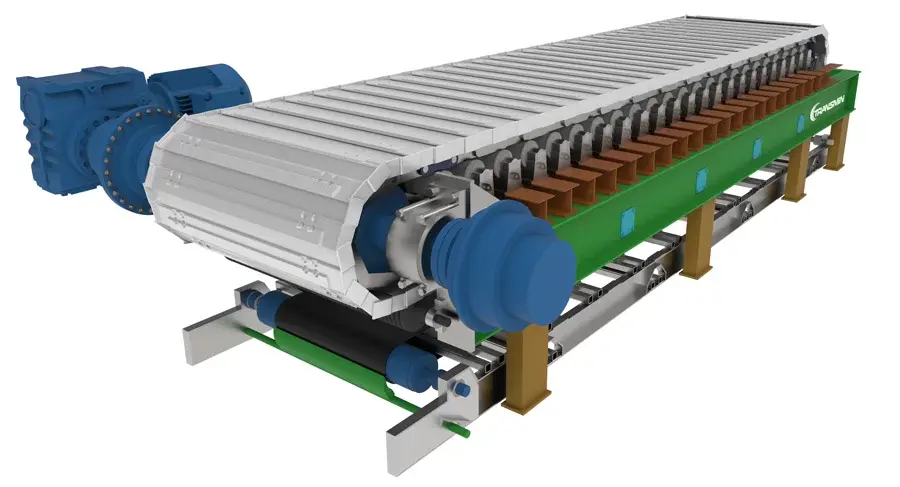
An apron feeder uses interlocking steel pans mounted on heavy-duty chains to form a continuous, rigid carrying surface. The all-steel construction absorbs the kind of impact loads and sustained stress that would quickly destroy a rubber belt. That makes it well suited to applications where material is being loaded directly from trucks, loaders, or hoppers at high volume.
Beyond raw durability, apron feeders also deliver precise, controlled feed rates to downstream crushers, screens, and conveyors. Uncontrolled surges in high-throughput operations cause bottlenecks, accelerated wear, and costly unplanned downtime. Apron feeders eliminate that risk.
Common applications of apron feeders
- Run-of-mine ore handling
- Primary crushing circuits
- Stockpile reclaim
- High-capacity material transfer
- High-temperature and abrasive material handling
Benefits of apron feeders for heavy-duty applications
1. Rugged construction
The steel pan design, robust frame, reinforced chain system, and industrial-grade components are selected to withstand continuous loads in harsh mining conditions. Transmin’s heavy-duty apron feeders are custom-designed with pan widths up to 4 metres, engineered to suit the specific application rather than adapted from a standard catalogue product. Transmin also uses BERCO SALT chain, sprockets, wheels, and rollers, components proven in the most demanding ROM applications at D9 and D11 dozer-level duty.
This construction makes apron feeders suited to operations handling iron ore, copper ore, gold ore, lithium, aggregates, and other high-density bulk solids. They are also a reliable choice for high-temperature applications, including materials exceeding 200°C, where rubber belts would quickly fail. It is one of the primary reasons apron feeders remain the preferred choice for primary feeding applications across the mining industry.
2. Impact resistance
Impact loading is one of the biggest challenges in bulk materials handling. The steel pan design absorbs impact forces far more effectively than conventional rubber belts, significantly reducing the risk of deformation, tearing, or premature failure beneath dump hoppers, primary crushers, and truck unloading stations where high-impact loads are unavoidable.
In demanding mining environments, this directly translates into longer service intervals and lower replacement costs over the life of the equipment.
3. Material handling capabilities
Apron feeders handle a wide range of materials that cause problems for conventional equipment. Large lump sizes, wet and sticky ores, highly abrasive material, and variable feed rates at high tonnage are all within their scope. The chain-driven steel pan design keeps material moving reliably even under difficult conditions, and the pan geometry Transmin uses minimises material leakage on the return.
For applications requiring an ultra-low profile or a combined feeder-conveyor layout that transitions from horizontal to inclined within a single machine, Transmin’s Low Profile Feeder (LPF) is worth considering, with belt widths up to 4 metres and throughput of 6,000 tph and above.
4. Controlled material flow
Consistent material flow is critical for downstream processing efficiency. Uncontrolled surges or erratic feed rates accelerate wear on crushers and disrupt plant performance. In high-throughput operations, that is an expensive problem to manage after the fact.
Transmin’s apron feeders are available with optional variable speed drive, giving operators real-time control over feed rates and protecting downstream equipment from surge loading. Pairing the feeder with quality conveyor components downstream further optimises the flow of material through your handling system, reducing bottlenecks and improving overall productivity.
Finding the right apron feeder for your operation
When operations involve abrasive materials, high-impact loading, and continuous heavy-duty operation, apron feeders remain one of the most reliable solutions available. Choosing the wrong feeder leads to accelerated wear, unplanned downtime, and throughput bottlenecks that affect your entire operation.
Transmin has nearly 40 years of experience specifying and supplying feeders across the full range of bulk materials handling applications, from heavy-duty ROM operations in the Pilbara to process environments worldwide. If you are working through a feeder selection for a new project or a replacement, the Transmin engineering team is worth talking to early.
Get in touch with the Transmin team today to talk through your application.

TH Group nombra a Transmin
TH Appoints Transmin as Sales & Service Agent for Australia, Southeast Asia, Canada and the United States

TH is pleased to announce the appointment of Transmin as its new sales & service agent for Australia, Southeast Asia, Canada and the United States. Through this strategic partnership, Transmin will represent and promote TH’s advanced dewatering and filtration solutions for the mining industry, further strengthening the company’s presence in key mining markets worldwide.
In addition to its commercial responsibilities, Transmin will also manage TH’s spare parts warehouse in Perth, Australia, enhancing local support capabilities and ensuring faster access to critical components for mining operations across the region.
Established in 1987, Transmin is a leading provider of innovative equipment and engineering solutions for the mining and bulk materials handling industries. Headquartered in Perth, Western Australia, the company has built a strong reputation for delivering high-quality technologies and technical support to mining operations globally. With extensive experience across a wide range of commodities and processing applications, Transmin is well positioned to support customers throughout the regions covered by this agreement.
TH has been active in the global mining sector for more than 60 years, working alongside some of the industry’s leading companies, including Glencore, Anglo American, Lynas Corp, Tianqi Lithium and Alkhem. Throughout this time, TH has developed and supplied filtration and dewatering solutions for mineral concentrates, rare earths and tailings management projects in mining operations around the world.
The appointment of Transmin represents an important step in TH’s international growth strategy. By combining TH’s expertise in dewatering and filtration technologies with Transmin’s strong market presence and technical capabilities, both companies aim to deliver an enhanced level of service, responsiveness and value to mining customers across these strategic markets.
We look forward to a successful partnership and to continuing to support mining operations with innovative, reliable and efficient dewatering solutions.
About TH COMPANY
TH COMPANY is an international industrial company that helps its customers process natural resources efficiently through the design, building, sale and servicing of equipment and installations for fishing, mining and other industrial processes.
Cómo elegir la zaranda transportadora correcta: Una guía práctica para operaciones mineras y de materiales a granel
Apron feeders are key to some of the most demanding environments in mining and bulk materials handling, but selecting the right one requires more than a quick spec check. Get it right, and you have a piece of equipment that will perform consistently for years. Get it wrong, and you are looking at costly downtime, accelerated wear, and throughput bottlenecks you could have avoided.
This guide walks through the key considerations to help you make a well-informed decision.

What is an apron feeder?
An apron feeder is a heavy-duty material handling machine that uses interlocking steel pans mounted on chains to form a continuous moving surface. This surface carries materials steadily from one point to another, without slipping or spilling, while distributing loads evenly across the structure.
Unlike conventional belt conveyors that degrade under sustained stress, apron feeders are built for conditions where standard equipment simply would not last. High temperatures, corrosive environments, continuous run-of-mine (ROM) duty, heavy and abrasive ores: these are the applications where an apron feeder proves its value. The steel pan design absorbs impact loads that would destroy a rubber belt, making the apron feeder conveyor the logical choice where material is being loaded directly from trucks, loaders, or hoppers at volume.
They are also highly versatile. Apron feeders serve as primary feeders beneath stockpiles and hoppers, as reclaim feeders, and as a controlled feed source to crushers, screens, and downstream conveyors.
Factors to consider when selecting an apron feeder
1. Material type and size
Your material is the starting point for every design decision. Free-flowing granular materials like gravel require relatively simple configurations, while high-density materials such as iron ore demand more powerful drive systems. For low-density materials, feeder speed needs careful calibration to hit the required tonnes per hour.
Moisture content affects flow behaviour significantly. Wet, sticky materials need self-cleaning features to prevent build-up, while very dry or fine materials introduce dust control requirements. Particle size and gradation round out the picture: oversized or irregular feed places different loads on the pans and chain, so understanding the full size range is essential before specifying equipment.
2. Capacity and throughput requirements
Define your normal and peak feed rates before selecting a drive system. Where throughput is consistent, a fixed-speed drive is straightforward and cost-effective. Where demand fluctuates, a variable speed drive gives you real-time control and protects downstream equipment from surge loading. Electric drives suit continuous-duty operations, while hydraulic drives handle high-torque starting conditions well. Transmin’s alimentadores de delantal are available with optional hydraulic drive for demanding applications.
3. Feeding and discharging conditions
The hopper shear length, the opening dimension directly above the feeder, is one of the most important sizing parameters and directly influences drive system selection. The loading method matters too: impact loads from trucks or loaders must be accounted for in the feed inlet design to prevent premature wear.
On the discharge side, feeding into a crusher requires careful attention to chute design and feed rate control, while discharging onto a downstream apron feeder conveyor introduces belt speed and trajectory considerations.
4. Operating angle
Steeper angles suit free-flowing materials, while wet or viscous materials need a shallower incline to maintain consistent flow. If your application requires a horizontal-to-inclined transition within a single machine, Transmin’s Alimentador de bajo perfil is designed for exactly that.
5. Site and environmental conditions
High-temperature applications such as molten slag transport require heat-resistant construction throughout, making an all-steel apron feeder the only practical option. Cold environments may need insulation provisions. Site altitude affects motor cooling, so electrical specifications must be confirmed against local conditions, and physical space constraints should be established early to avoid costly design changes later.
6. Customisation and design options
No two sites are identical. Belt widths, pan configurations, drive arrangements, and ancillary equipment such as dribble conveyors can all be tailored to your application. Transmin’s alimentadores de delantal are custom designed with belt widths up to 3 metres. For applications needing an ultra-low profile or a combined feeder-conveyor solution, the Alimentador de bajo perfil extends the range further, with belt widths up to 4 metres and throughput of 6,000 tph and above.
Getting the right equipment for your application
Selecting the right apron feeder is a technical decision with long-term operational consequences. The factors above do not exist in isolation: material characteristics, throughput requirements, site conditions, and discharge arrangements all interact, and a change in any one of them can influence the others.
Transmin’s engineering team has over 35 years of experience specifying and supplying feeders for the full range of bulk materials handling applications, from heavy-duty ROM operations in the Pilbara to challenging process environments worldwide. Our team can help you work through the variables and identify the best solution.
Ponte en contacto with us to discuss your application and find the right feeder for your operation.

Estudio de Caso: Transmin ConveyorPro
Project Overview:
Transmin has worked with this Western Australian contracting business (‘the client’) for a number of years, supporting them in successfully delivering their services to end users. For this specific engagement, we designed, manufactured, and supplied complete conveyor components to support their customer’s completion of their Engineering, Procurement and Construction (EPC) contract in the Goldfields-Esperance region.

The Challenge:
The client’s customer needed application-specific conveyor components for their regional EPC project. Having already sold numerous capital items to the client and the project, Transmin became an obvious choice. On top of our quality service, we were able to offer convenience to the client by enabling them to procure a wide range of goods through the one trusted supplier.
The Solution:
Working closely with our Business Develop Manager for Conveyors and our dedicated Conveyor Engineer, we were able to identify and supply the best possible idlers, pulleys and belts for the project. As a distributor of Martin Engineering products, we were also able to provide custom-designed impact beds to suit specific application requirements.

The Challenge:
The client’s customer needed application-specific conveyor components for their regional EPC project. Having already sold numerous capital items to the client and the project, Transmin became an obvious choice. On top of our quality service, we were able to offer convenience to the client by enabling them to procure a wide range of goods through the one trusted supplier.
The Solution:
Working closely with our Business Develop Manager for Conveyors and our dedicated Conveyor Engineer, we were able to identify and supply the best possible idlers, pulleys and belts for the project. As a distributor of Martin Engineering products, we were also able to provide custom-designed impact beds to suit specific application requirements.

Los elementos de los sistemas de protección de cintas transportadoras eficaces
Conveyor systems feature numerous moving parts, including belts, pulleys, and rollers. Coming into contact with these parts can lead to severe injury. In fact, without a physical barrier, personnel are at risk of entanglement, crushing, amputation, and electrical shock.
That’s why having an effective conveyor guarding system is so important.

What is conveyor guarding?
Conveyor guarding is a key safety measure to ensure safe operation and maintenance of conveyor equipment in industrial environments. By installing protective barriers, covers, and devices around your conveyor system, you’re minimising the risk of injury in the workplace and protecting the people who operate and maintain your system.
Essential conveyor guarding components
Protege a los trabajadores de partes móviles
To ensure staff safety, it’s vital to install fixed belt conveyor guarding that acts as a solid barrier between people and machinery. Where pulleys and rotating components are exposed, fencing should also be installed to isolate these hazards and prevent accidental contact. This simple measure greatly reduces the risk of entanglement and other serious injuries.
Where powered conveyors transfer goods to idle rollers, pop-out rollers should be installed. These mitigate against trapping hazards by releasing under pressure, preventing crush injuries in transfer zones. Additionally, any crossovers should be equipped with stairs and sturdy handrails, giving workers a safe way to pass over conveyors without stepping onto or across the moving system.
Complies with safety standards and regulations
Conveyor guarding requirements are outlined in AS/NZS 4024.3610, the primary standard governing the safe design, installation, and maintenance of all conveyor systems. Depending on the type of system, this may be applied alongside other conveyor guarding standards, including AS 4024.3611 (belt conveyors for bulk material handling) and AS 4024.3614(mobile and transportable conveyors). Together, these form part of the AS 4024.1 Safety of Machinery series, which aims to minimise health and safety risks throughout a conveyor’s lifecycle, whether installed above or below ground.
Compliance with these standards also supports obligations under Work Health and Safety (WHS) regulations, which require employers to identify and control hazards to protect workers and others in the workplace. Regular inspection, proper guarding, and adherence to AS/NZS guidelines ensure conveyors remain both safe and compliant.
Provides easy access for maintenance without compromising safety
Safe access for maintenance teams can be achieved through thoughtful design and proper safety integration. While fixed guards are always preferable, interlocked guardsare an effective alternative that allows access for maintenance personnel while maintaining safety.
Conveyors should also feature emergency stop controls positioned within easy reach along maintenance areas, enabling quick shutdowns if needed. Where possible, design the system with maintenance in mind, such as including hinged or removable guards, slide-out components, and remote lubrication points. This approach allows technicians to perform essential work efficiently without compromising safety or compliance.
Uses durable materials suited for the environment
In mining and other heavy-duty industrial environments, conveyor guarding systems must withstand harsh operating conditions. Common durable materials include:
- UHMWPE (Ultra-high-molecular-weight polyethylene)
- Stainless steel 316
- Galvanised steel
By combining these materials strategically, you can maximise the lifespan and reliability of your conveyor guarding infrastructure.
Conveyor guarding with Transmin ConveyorPro
Transmin ConveyorPro is a global provider of GuardLitePro, a lightweight, high-performance UHMWPE guarding solution. GuardLitePro is designed to fit a wide range of conveyors, from heavy-duty mining to mineral processing applications.Want to learn more about our conveyor guarding solutions? Get in touch today, and our experienced team will help you find the right fit for your needs.

Soluciones de rompe rocas de alta resistencia explicadas
En las operaciones de minería y procesamiento de minerales, es común encontrar rocas que no pueden ser procesadas directamente por trituradoras u otro equipo de manejo de materiales.
Por eso, los rompedores de roca de gran resistencia son un equipo invaluable en situaciones donde roca extremadamente dura debe ser fragmentado de manera eficiente y segura.
En este blog, examinamos diferentes tipos de fragmentación de roca soluciones y sus aplicaciones.
¿Qué es un martillo hidráulico de uso rudo?
Las trituradoras de roca generalmente consisten en tres componentes clave:
- Un martillo hidráulico que rompe la roca
- Un auge que posiciona el martillo
- Un sistema de potencia hidráulica que asegura un nivel de fuerza suficiente y constante
Estos componentes funcionan en conjunto para golpear rocas repetidamente hasta que fracturarse en pedazos más pequeños, realizando así la función de rompedor de rocas.

Soluciones rompe rocas BoomerHD
Protege a los trabajadores de partes móviles
Basándonos en años de refinamiento de diseño y experiencia en algunos de los las trituradoras de troceado y giratorias más grandes del mundo aplicaciones, Transmin ha seguido avanzando en su tecnología de trituración de roca.
Lo más reciente Serie BoomerHD está diseñado para operaciones a gran escala de minería y procesamiento de minerales. Diseñadas para ofrecer mayor resistencia, operación más rápida y durabilidad mejorada, estas rompedoras de roca también ofrecen intervalos de mantenimiento más largos y menores costos generales del ciclo de vida, lo que refleja el compromiso continuo de Transmin con el diseño práctico de alto rendimiento.
La serie está compuesta por tres modeloslas series 100, 130 y 160. Todos los modelos incluyen las siguientes características:
- Cilindros de alta resistencia adecuados para las condiciones más difíciles
- Sistema de bloqueo mecánico de buje cónico Taper Lock
- Control remoto RockLogic opcional para facilitar su uso
- Componentes probados que se alinean con los estándares de la industria
Rompedores hidráulicos BoomerHD Serie 100
Especificaciones clave
- Alcance vertical: hasta 6.9 m
- Alcance horizontal: hasta 10.6 m
- Roca UCS: 60–320MPa
Aplicaciones
La serie BoomerHD 100 está diseñada para escala mediana a grande operaciones de procesamiento de minerales y materiales, particularmente en estaciones de trituradoras de parrilla y giratorias. Su diseño compacto, alta resistencia a la tracción y rendimiento hidráulico controlado lo hacen ideal para instalaciones donde el espacio es limitado pero la confiabilidad y la precisión son cruciales.
Rompedores de roca BoomerHD serie 130
Especificaciones clave
- Alcance vertical: hasta 8,7 m
- Alcance horizontal: hasta 13,8 m
- Roca UCS: 100–320MPa
Aplicaciones
La serie BoomerHD 130 está diseñada para operaciones mineras de trabajo pesado que requieren mayor alcance y capacidad de impacto. Es muy adecuado para grandes estaciones trituradoras y zonas de manejo de materiales de alto rendimiento, donde proporciona cobertura extendida y mayores presiones hidráulicas para una eficiencia de trituración mejorada.
Rompedores de roca BoomerHD Serie 160
Especificaciones clave
- Alcance vertical: hasta 11,8 m
- Alcance horizontal: hasta 17.5m
- Roca UCS: 160–320MPa Plus
Aplicaciones
La Serie BoomerHD 160 es de Transmin el rompemuros más grande y potente, diseñado para entornos de minería y procesamiento de minerales ultraduros. Con su sistema hidráulico de doble tracción y un alcance excepcional, es capaz de triturar roca extremadamente dura de manera eficiente en instalaciones fijas de gran tamaño y operaciones continuas.
Funciones adicionales opcionales de BoomerHD
Las siguientes características opcionales se pueden añadir a todos los modelos de la serie BoomerHD:
- Acople rápido
- Grifos
- Cañón de agua y rasqueta
Proveedor líder de rompedores de roca
Los rompedores de roca son cruciales para prevenir bloqueos en las trituradoras, mantener un flujo continuo de material y mejorar la seguridad del sitio.
Nuestro BoomerHD cubre el rango todo el espectro de aplicaciones de trituración de roca. Consulte con nuestro experimentado equipo para determinar qué modelo se adapta mejor a sus necesidades.
Terms & Conditions