Resources
To view the files provided below you need to have Adobe Acrobat Reader installed on your computer. To install Acrobat Reader please visit the Adobe Web Site.

Click here to read Transmin’s capabilities and services.
Lime Preparation Plants Overview
Flocculant & Reagent Systems Overview
Ball Charging Systems Overview
TH Group
APN Filter Press – TH Group
APNH Filter Press – TH Group
EBBD Fliter Press – TH Group
ECLW Fliter Press – TH Group
DT Drip Tray – TH Group
LPF – Copper Filter Cake Handling
LPF – Two Identical D9, 46m Long
LPF – Swan Neck Configuration
LPF – Reduced Maintenance, Increased Safety
LPF – Reclaim Hopper for Iron Ore Tailings
LPF – Retractable LPF for Filter Press Application
LPF – Widest on the Market
LPF – Ongoing LPFs to Africa
Belt Feeders – 12 Belt Feeders to Convey Filter Cake

Berita Terbaru

Aplikasi Pengumpan Sekrup Industri Tugas Berat
Memindahkan material curah dari satu titik ke titik lain adalah tantangan yang sangat bervariasi tergantung pada apa yang Anda tangani. Beberapa material mengalir bebas dan dapat diprediksi; yang lain bersifat abrasif, korosif, lengket, atau tunduk pada suhu ekstrem. Pengumpan sekrup mengatasi tantangan ini dengan desain tertutup yang sederhana yang memberikan aliran terkontrol dan terukur di berbagai aplikasi industri.
Artikel ini mengulas keuntungan utama pengumpan sekrup, aplikasi yang dilayaninya, dan berbagai material curah yang ditanganinya secara efektif.

Keunggulan Pengumpan Baut
Pengumpan ulir adalah salah satu peralatan paling serbaguna dalam penanganan material curah. Desain intinya — ulir heliks yang berputar di dalam palung atau tabung tertutup — memindahkan material pada laju yang terkontrol, menjadikannya cocok untuk aplikasi di mana presisi, penahanan, dan keandalan penting.
1. Ringkas dan Hemat Ruang
Pengumpan sekrup membutuhkan ruang yang relatif kecil dibandingkan dengan sistem konveyor lainnya. Hal ini membuat mereka cocok untuk pabrik pengolahan, kilang, dan fasilitas industri di mana ruang terbatas. Pengumpan sekrup vertikal melangkah lebih jauh, memindahkan material ke atas dalam ruang yang sempit dengan akses mudah untuk perawatan.
2. Pengukuran Material yang Tepat
Salah satu fitur paling berharga dari pengumpan sekrup adalah kemampuannya untuk mengukur material pada laju yang terkontrol dan konsisten. Dengan menyesuaikan kecepatan penggerak, operator dapat mengatur laju umpan yang tepat untuk mengurangi pembebanan lonjakan, meningkatkan efisiensi proses, dan melindungi peralatan hilir dari kelebihan beban.
3. Desain Tertutup untuk Pengendalian Debu dan Tumpahan
Berbeda dengan sistem transfer terbuka, pengumpan sekrup beroperasi di dalam palung atau tabung tertutup. Ini menahan debu, meminimalkan tumpahan, dan meningkatkan kebersihan di area pemrosesan. Untuk industri yang menangani bubuk halus atau bahan yang sensitif terhadap lingkungan, pengangkutan tertutup dapat meningkatkan kebersihan operasional dan keselamatan kerja.
4. Cocok untuk Material Sulit
Pemberi makan sekrup mampu menangani berbagai macam bahan curah, termasuk bubuk, butiran, pasir, semen, kapur, konsentrat mineral, agregat, dan produk limbah industri. Desain sekrup yang berbeda dapat disesuaikan untuk memenuhi berbagai karakteristik material, termasuk produk yang abrasif, lengket, atau memiliki kadar air tinggi.
Aplikasi Pengumpan Ulir
Transmin pengumpan sekrup tugas berat sistem digunakan di berbagai industri di mana transfer material yang terkendali dan throughput yang andal tidak dapat ditawar.
1. Pertambangan dan Pengolahan Mineral
Operasi penambangan umum menggunakan pengumpan ulir untuk memindahkan bijih halus, konsentrat, reagen, dan mineral olahan antar tahapan peralatan. Di lingkungan ini, pengumpan ulir membantu menjaga aliran terkendali ke konveyor, sistem pencampuran, peralatan pemrosesan, silo penyimpanan, dan sistem pengemasan. Operasi tertutupnya juga membantu mengurangi pembentukan debu saat menangani produk mineral kering atau halus.
2. Operasi Semen dan Quarry
Pabrik semen dan operasi penambangan mengandalkan pengumpan ulir untuk menangani bahan bubuk dan granular seperti semen, abu terbang, kapur, dan agregat. Kontrol umpan yang konsisten yang disediakan oleh pengumpan ulir mendukung proses penakaran dan pencampuran yang stabil sambil mengurangi limbah material.
3. Pabrik Pengolahan Industri
Pengumpan ulir banyak digunakan dalam operasi kimia, pupuk, pengolahan makanan, dan manufaktur di mana material perlu ditransfer dengan aman dan konsisten. Tergantung pada aplikasinya, sistem dapat dirancang untuk pengumpanan terukur, laju aliran variabel, material bersuhu tinggi, produk korosif, atau lingkungan pemrosesan higienis.
4. Aplikasi Limbah dan Daur Ulang
Dalam operasi penanganan limbah, pengumpan ulir membantu memindahkan lumpur, abu, biomassa, bahan daur ulang, dan produk samping industri melalui sistem pengolahan. Desain tertutupnya menampung bau, debu, dan kontaminan di sumbernya, mengurangi risiko kontaminasi silang dan menjaga area pengolahan sesuai dengan persyaratan lingkungan dan keselamatan.
Penangan Material Curah Dengan Pengumpan Sekrup
Pengumpan sekrup yang dirancang dengan baik menangani berbagai macam bahan curah secara andal. Berikut ini adalah beberapa bahan yang paling umum digunakan dalam pengumpan sekrup Transmin:
- Kapur dan kapur tohor: digunakan secara luas dalam pertambangan, pengolahan mineral, netralisasi asam, dan pengolahan air limbah. Transmin telah menyediakan pengumpan sekrup untuk aplikasi kapur tohor di sejumlah fasilitas pemrosesan di Australia Barat.
- Bijih dan mineral: termasuk bijih besi, bijih tembaga, nikel, dan material berdensitas tinggi serupa yang memerlukan konstruksi kokoh dan komponen tahan aus.
- Semen dan konsentrat bubuk: material kering, halus di mana desain tertutup dari pengumpan sekrup sangat penting untuk pengendalian debu dan dosis yang akurat.
- Biji-bijian: produk pertanian yang mengalir bebas yang mendapat manfaat dari penanganan yang lembut dan konsisten yang disediakan oleh pengumpan ulir.
- Bahan korosif dan bersuhu tinggi: aplikasi yang melibatkan kondisi ekstrem, termasuk lingkungan bertekanan atau vakum, ditangani dengan konstruksi baja tahan karat dan pengaturan penyegelan yang sesuai.
Untuk operasi yang mengintegrasikan berbagai teknologi pengangkutan, Transmin juga mendukung lebih luas solusi penanganan material curah di lingkungan pertambangan dan pemrosesan industri.
Tentukan Pengumpan Sekrup yang Tepat untuk Aplikasi Anda
Penyuap ulir adalah solusi yang andal dan hemat ruang untuk berbagai tantangan penanganan material curah. Mulai dari pertambangan dan penggalian hingga pemrosesan kimia dan penanganan limbah, penyuap ulir yang dirancang dengan baik meningkatkan efisiensi pengangkutan, mengurangi kehilangan material, dan mendukung kinerja pabrik yang andal dalam kondisi yang menuntut.
Transmisi menawarkan rangkaian lengkap pengumpan sekrup industri tugas berat, termasuk model Scutti standar dan solusi yang dirancang khusus, didukung oleh pengalaman rekayasa selama hampir 40 tahun.
Hubungi kami bersama tim kami untuk membahas lamaran Anda dan menemukan kecocokan yang tepat.

Kondisi Sulit? Apron Feeder untuk Aplikasi Berat
Run-of-mine ore arriving directly from the pit is about as unforgiving a feed source as you will find. Oversized rock, unpredictable lump size, high impact loads, and continuous duty mean most feeders are not built to handle all of that at once.
Heavy-duty pemberi makan apron are built specifically for those conditions. When the material is heavy, abrasive, and arriving at volume, apron feeders are the equipment most operations turn to first.

Why choose an apron feeder over a conventional one?
Conventional belt feeders perform well in standard conditions, but they have clear limitations. Rubber belts degrade rapidly under sustained impact loads, abrasive materials, and high-temperature environments. When the application involves heavy, jagged ROM rock or continuous high-tonnage duty, belt feeders simply cannot keep pace.
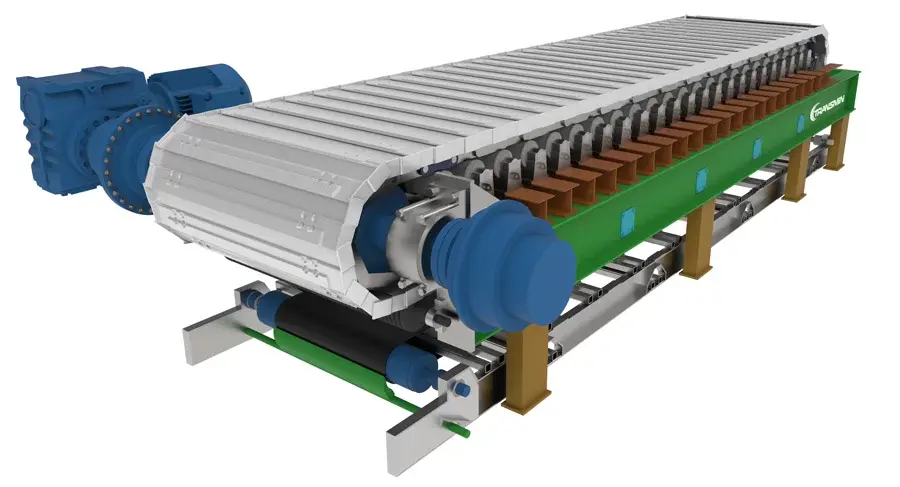
An apron feeder uses interlocking steel pans mounted on heavy-duty chains to form a continuous, rigid carrying surface. The all-steel construction absorbs the kind of impact loads and sustained stress that would quickly destroy a rubber belt. That makes it well suited to applications where material is being loaded directly from trucks, loaders, or hoppers at high volume.
Beyond raw durability, apron feeders also deliver precise, controlled feed rates to downstream crushers, screens, and conveyors. Uncontrolled surges in high-throughput operations cause bottlenecks, accelerated wear, and costly unplanned downtime. Apron feeders eliminate that risk.
Common applications of apron feeders
- Run-of-mine ore handling
- Primary crushing circuits
- Stockpile reclaim
- High-capacity material transfer
- High-temperature and abrasive material handling
Benefits of apron feeders for heavy-duty applications
1. Rugged construction
The steel pan design, robust frame, reinforced chain system, and industrial-grade components are selected to withstand continuous loads in harsh mining conditions. Transmin’s heavy-duty apron feeders are custom-designed with pan widths up to 4 metres, engineered to suit the specific application rather than adapted from a standard catalogue product. Transmin also uses BERCO SALT chain, sprockets, wheels, and rollers, components proven in the most demanding ROM applications at D9 and D11 dozer-level duty.
This construction makes apron feeders suited to operations handling iron ore, copper ore, gold ore, lithium, aggregates, and other high-density bulk solids. They are also a reliable choice for high-temperature applications, including materials exceeding 200°C, where rubber belts would quickly fail. It is one of the primary reasons apron feeders remain the preferred choice for primary feeding applications across the mining industry.
2. Impact resistance
Impact loading is one of the biggest challenges in bulk materials handling. The steel pan design absorbs impact forces far more effectively than conventional rubber belts, significantly reducing the risk of deformation, tearing, or premature failure beneath dump hoppers, primary crushers, and truck unloading stations where high-impact loads are unavoidable.
In demanding mining environments, this directly translates into longer service intervals and lower replacement costs over the life of the equipment.
3. Material handling capabilities
Apron feeders handle a wide range of materials that cause problems for conventional equipment. Large lump sizes, wet and sticky ores, highly abrasive material, and variable feed rates at high tonnage are all within their scope. The chain-driven steel pan design keeps material moving reliably even under difficult conditions, and the pan geometry Transmin uses minimises material leakage on the return.
For applications requiring an ultra-low profile or a combined feeder-conveyor layout that transitions from horizontal to inclined within a single machine, Transmin’s Low Profile Feeder (LPF) is worth considering, with belt widths up to 4 metres and throughput of 6,000 tph and above.
4. Controlled material flow
Consistent material flow is critical for downstream processing efficiency. Uncontrolled surges or erratic feed rates accelerate wear on crushers and disrupt plant performance. In high-throughput operations, that is an expensive problem to manage after the fact.
Transmin’s apron feeders are available with optional variable speed drive, giving operators real-time control over feed rates and protecting downstream equipment from surge loading. Pairing the feeder with quality conveyor components downstream further optimises the flow of material through your handling system, reducing bottlenecks and improving overall productivity.
Finding the right apron feeder for your operation
When operations involve abrasive materials, high-impact loading, and continuous heavy-duty operation, apron feeders remain one of the most reliable solutions available. Choosing the wrong feeder leads to accelerated wear, unplanned downtime, and throughput bottlenecks that affect your entire operation.
Transmin has nearly 40 years of experience specifying and supplying feeders across the full range of bulk materials handling applications, from heavy-duty ROM operations in the Pilbara to process environments worldwide. If you are working through a feeder selection for a new project or a replacement, the Transmin engineering team is worth talking to early.
Get in touch with the Transmin team today to talk through your application.

TH Group Menunjuk Transmin
TH Menunjuk Transmin Sebagai Agen Penjualan & Servis untuk Australia, Asia Tenggara, Kanada dan Amerika Serikat

TH dengan bangga mengumumkan penunjukan Transmin sebagai agen penjualan & servis baru mereka untuk Australia, Asia Tenggara, Kanada, dan Amerika Serikat. Melalui kemitraan strategis ini, Transmin akan mewakili dan mempromosikan solusi dewatering dan filtrasi canggih TH untuk industri pertambangan, yang semakin memperkuat kehadiran perusahaan di pasar pertambangan utama di seluruh dunia.
Selain tanggung jawab komersialnya, Transmin juga akan mengelola gudang suku cadang TH di Perth, Australia, meningkatkan kemampuan dukungan lokal dan memastikan akses yang lebih cepat ke komponen penting untuk operasi penambangan di seluruh wilayah tersebut.
Didirikan pada tahun 1987, Transmin adalah penyedia terkemuka peralatan inovatif dan solusi rekayasa untuk industri pertambangan dan penanganan material curah. Berkantor pusat di Perth, Australia Barat, perusahaan ini telah membangun reputasi yang kuat dalam menghadirkan teknologi berkualitas tinggi dan dukungan teknis untuk operasi pertambangan di seluruh dunia. Dengan pengalaman luas di berbagai komoditas dan aplikasi pemrosesan, Transmin berada dalam posisi yang baik untuk mendukung pelanggan di seluruh wilayah yang tercakup oleh perjanjian ini.
TH telah aktif di sektor pertambangan global selama lebih dari 60 tahun, bekerja bersama beberapa perusahaan terkemuka di industri ini, termasuk Glencore, Anglo American, Lynas Corp, Tianqi Lithium, dan Alkhem. Selama ini, TH telah mengembangkan dan memasok solusi filtrasi dan dewatering untuk proyek konsentrat mineral, tanah jarang, dan pengelolaan tailing di operasi pertambangan di seluruh dunia.
Penunjukan Transmin merupakan langkah penting dalam strategi pertumbuhan internasional TH. Dengan menggabungkan keahlian TH dalam teknologi dewatering (pengeringan lumpur) dan filtrasi dengan kehadiran pasar Transmin yang kuat dan kemampuan teknisnya, kedua perusahaan bertujuan untuk memberikan tingkat layanan, responsivitas, dan nilai yang lebih baik kepada pelanggan pertambangan di pasar-pasar strategis ini.
Kami menantikan kemitraan yang sukses dan terus mendukung operasi pertambangan dengan solusi dewatering yang inovatif, andal, dan efisien.
Tentang TH COMPANY
TH COMPANY adalah perusahaan industri internasional yang membantu pelanggannya memproses sumber daya alam secara efisien melalui desain, pembangunan, penjualan, dan servis peralatan serta instalasi untuk perikanan, pertambangan, dan proses industri lainnya.
Memilih Pengumpan Apron yang Tepat: Panduan Praktis untuk Operasi Pertambangan dan Material Curah
Apron feeders are key to some of the most demanding environments in mining and bulk materials handling, but selecting the right one requires more than a quick spec check. Get it right, and you have a piece of equipment that will perform consistently for years. Get it wrong, and you are looking at costly downtime, accelerated wear, and throughput bottlenecks you could have avoided.
This guide walks through the key considerations to help you make a well-informed decision.

What is an apron feeder?
An apron feeder is a heavy-duty material handling machine that uses interlocking steel pans mounted on chains to form a continuous moving surface. This surface carries materials steadily from one point to another, without slipping or spilling, while distributing loads evenly across the structure.
Unlike conventional belt conveyors that degrade under sustained stress, apron feeders are built for conditions where standard equipment simply would not last. High temperatures, corrosive environments, continuous run-of-mine (ROM) duty, heavy and abrasive ores: these are the applications where an apron feeder proves its value. The steel pan design absorbs impact loads that would destroy a rubber belt, making the apron feeder conveyor the logical choice where material is being loaded directly from trucks, loaders, or hoppers at volume.
They are also highly versatile. Apron feeders serve as primary feeders beneath stockpiles and hoppers, as reclaim feeders, and as a controlled feed source to crushers, screens, and downstream conveyors.
Factors to consider when selecting an apron feeder
1. Material type and size
Your material is the starting point for every design decision. Free-flowing granular materials like gravel require relatively simple configurations, while high-density materials such as iron ore demand more powerful drive systems. For low-density materials, feeder speed needs careful calibration to hit the required tonnes per hour.
Moisture content affects flow behaviour significantly. Wet, sticky materials need self-cleaning features to prevent build-up, while very dry or fine materials introduce dust control requirements. Particle size and gradation round out the picture: oversized or irregular feed places different loads on the pans and chain, so understanding the full size range is essential before specifying equipment.
2. Capacity and throughput requirements
Define your normal and peak feed rates before selecting a drive system. Where throughput is consistent, a fixed-speed drive is straightforward and cost-effective. Where demand fluctuates, a variable speed drive gives you real-time control and protects downstream equipment from surge loading. Electric drives suit continuous-duty operations, while hydraulic drives handle high-torque starting conditions well. Transmin’s pemberi makan apron are available with optional hydraulic drive for demanding applications.
3. Feeding and discharging conditions
The hopper shear length, the opening dimension directly above the feeder, is one of the most important sizing parameters and directly influences drive system selection. The loading method matters too: impact loads from trucks or loaders must be accounted for in the feed inlet design to prevent premature wear.
On the discharge side, feeding into a crusher requires careful attention to chute design and feed rate control, while discharging onto a downstream apron feeder conveyor introduces belt speed and trajectory considerations.
4. Operating angle
Steeper angles suit free-flowing materials, while wet or viscous materials need a shallower incline to maintain consistent flow. If your application requires a horizontal-to-inclined transition within a single machine, Transmin’s Pengumpan Profil Rendah (LPF) is designed for exactly that.
5. Site and environmental conditions
High-temperature applications such as molten slag transport require heat-resistant construction throughout, making an all-steel apron feeder the only practical option. Cold environments may need insulation provisions. Site altitude affects motor cooling, so electrical specifications must be confirmed against local conditions, and physical space constraints should be established early to avoid costly design changes later.
6. Customisation and design options
No two sites are identical. Belt widths, pan configurations, drive arrangements, and ancillary equipment such as dribble conveyors can all be tailored to your application. Transmin’s pemberi makan apron are custom designed with belt widths up to 3 metres. For applications needing an ultra-low profile or a combined feeder-conveyor solution, the Pemberi Pakan Profil Rendah extends the range further, with belt widths up to 4 metres and throughput of 6,000 tph and above.
Getting the right equipment for your application
Selecting the right apron feeder is a technical decision with long-term operational consequences. The factors above do not exist in isolation: material characteristics, throughput requirements, site conditions, and discharge arrangements all interact, and a change in any one of them can influence the others.
Transmin’s engineering team has over 35 years of experience specifying and supplying feeders for the full range of bulk materials handling applications, from heavy-duty ROM operations in the Pilbara to challenging process environments worldwide. Our team can help you work through the variables and identify the best solution.
Hubungi kami with us to discuss your application and find the right feeder for your operation.

Studi Kasus: Transmin ConveyorPro
Project Overview:
Transmin has worked with this Western Australian contracting business (‘the client’) for a number of years, supporting them in successfully delivering their services to end users. For this specific engagement, we designed, manufactured, and supplied complete conveyor components to support their customer’s completion of their Engineering, Procurement and Construction (EPC) contract in the Goldfields-Esperance region.

The Challenge:
The client’s customer needed application-specific conveyor components for their regional EPC project. Having already sold numerous capital items to the client and the project, Transmin became an obvious choice. On top of our quality service, we were able to offer convenience to the client by enabling them to procure a wide range of goods through the one trusted supplier.
The Solution:
Working closely with our Business Develop Manager for Conveyors and our dedicated Conveyor Engineer, we were able to identify and supply the best possible idlers, pulleys and belts for the project. As a distributor of Martin Engineering products, we were also able to provide custom-designed impact beds to suit specific application requirements.

The Challenge:
The client’s customer needed application-specific conveyor components for their regional EPC project. Having already sold numerous capital items to the client and the project, Transmin became an obvious choice. On top of our quality service, we were able to offer convenience to the client by enabling them to procure a wide range of goods through the one trusted supplier.
The Solution:
Working closely with our Business Develop Manager for Conveyors and our dedicated Conveyor Engineer, we were able to identify and supply the best possible idlers, pulleys and belts for the project. As a distributor of Martin Engineering products, we were also able to provide custom-designed impact beds to suit specific application requirements.

Elemen-Elemen Sistem Pelindung Konveyor yang Efektif
Conveyor systems feature numerous moving parts, including belts, pulleys, and rollers. Coming into contact with these parts can lead to severe injury. In fact, without a physical barrier, personnel are at risk of entanglement, crushing, amputation, and electrical shock.
That’s why having an effective conveyor guarding system is so important.

What is conveyor guarding?
Conveyor guarding is a key safety measure to ensure safe operation and maintenance of conveyor equipment in industrial environments. By installing protective barriers, covers, and devices around your conveyor system, you’re minimising the risk of injury in the workplace and protecting the people who operate and maintain your system.
Essential conveyor guarding components
Melindungi pekerja dari bagian yang bergerak
To ensure staff safety, it’s vital to install fixed belt conveyor guarding that acts as a solid barrier between people and machinery. Where pulleys and rotating components are exposed, fencing should also be installed to isolate these hazards and prevent accidental contact. This simple measure greatly reduces the risk of entanglement and other serious injuries.
Where powered conveyors transfer goods to idle rollers, pop-out rollers should be installed. These mitigate against trapping hazards by releasing under pressure, preventing crush injuries in transfer zones. Additionally, any crossovers should be equipped with stairs and sturdy handrails, giving workers a safe way to pass over conveyors without stepping onto or across the moving system.
Complies with safety standards and regulations
Conveyor guarding requirements are outlined in AS/NZS 4024.3610, the primary standard governing the safe design, installation, and maintenance of all conveyor systems. Depending on the type of system, this may be applied alongside other conveyor guarding standards, including AS 4024.3611 (belt conveyors for bulk material handling) and AS 4024.3614(mobile and transportable conveyors). Together, these form part of the AS 4024.1 Safety of Machinery series, which aims to minimise health and safety risks throughout a conveyor’s lifecycle, whether installed above or below ground.
Compliance with these standards also supports obligations under Work Health and Safety (WHS) regulations, which require employers to identify and control hazards to protect workers and others in the workplace. Regular inspection, proper guarding, and adherence to AS/NZS guidelines ensure conveyors remain both safe and compliant.
Provides easy access for maintenance without compromising safety
Safe access for maintenance teams can be achieved through thoughtful design and proper safety integration. While fixed guards are always preferable, interlocked guardsare an effective alternative that allows access for maintenance personnel while maintaining safety.
Conveyors should also feature emergency stop controls positioned within easy reach along maintenance areas, enabling quick shutdowns if needed. Where possible, design the system with maintenance in mind, such as including hinged or removable guards, slide-out components, and remote lubrication points. This approach allows technicians to perform essential work efficiently without compromising safety or compliance.
Uses durable materials suited for the environment
In mining and other heavy-duty industrial environments, conveyor guarding systems must withstand harsh operating conditions. Common durable materials include:
- UHMWPE (Ultra-high-molecular-weight polyethylene)
- Stainless steel 316
- Galvanised steel
By combining these materials strategically, you can maximise the lifespan and reliability of your conveyor guarding infrastructure.
Conveyor guarding with Transmin ConveyorPro
Transmin ConveyorPro is a global provider of GuardLitePro, a lightweight, high-performance UHMWPE guarding solution. GuardLitePro is designed to fit a wide range of conveyors, from heavy-duty mining to mineral processing applications.Want to learn more about our conveyor guarding solutions? Get in touch today, and our experienced team will help you find the right fit for your needs.

Solusi Pemecah Batu Tugas Berat Dijelaskan
Dalam operasi penambangan dan pengolahan mineral, umum ditemui batuan yang tidak dapat diproses secara langsung oleh penghancur atau peralatan penanganan material lainnya.
Itulah sebabnya alat penghancur batu tugas berat adalah peralatan yang sangat berharga dalam situasi di mana batu yang sangat keras harus terfragmentasi secara efisien dan aman.
Dalam blog ini, kami mengkaji berbagai jenis pemecah batu solusi dan mereka aplikasi.
Pemecah batu tugas berat
Pemecah batu umumnya terdiri dari tiga komponen utama:
- Palu hidrolik yang memecahkan batu itu
- Ledakan yang memposisikan palu
- Sistem tenaga hidrolik yang memastikan tingkat tenaga yang cukup dan konsisten
Komponen-komponen ini bekerja bersama untuk berulang kali menghantam batu hingga mereka pecah menjadi bagian-bagian yang lebih kecil, sehingga menjalankan fungsi pemecah batu.

Solusi pemecah batu BoomerHD
Melindungi pekerja dari bagian yang bergerak
Berdasarkan penyempurnaan desain selama bertahun-tahun dan pengalaman dalam beberapa aplikasi penghancur grizzly dan gyratory terbesar di dunia, Transmin terus memajukan teknologi pemecah batunya.
Yang terbaru Seri BoomerHD dirancang untuk operasi pertambangan dan pengolahan mineral skala besar. Dirancang untuk memberikan kekuatan yang lebih besar, pengoperasian yang lebih cepat, dan daya tahan yang lebih baik, pemecah batu ini juga menawarkan interval perawatan yang lebih lama dan biaya siklus hidup keseluruhan yang lebih rendah, mencerminkan komitmen Transmin yang berkelanjutan terhadap desain praktis berkinerja tinggi.
Seri ini terdiri dari tiga model: Seri 100, 130, dan 160. Semua model mencakup fitur-fitur berikut:
- Silinder tugas berat yang sesuai untuk kondisi terberat
- Sistem penguncian mekanis taper lock bush assembly
- Kontrol jarak jauh RockLogic opsional untuk kemudahan penggunaan
- Komponen teruji yang selaras dengan standar industri
Pemecah Batu BoomerHD Seri 100
Spesifikasi Utama
- Jangkauan vertikal: hingga 6,9 m
- Jangkauan horizontal: hingga 10,6 m
- Batuan UCS: 60–320MPa
Aplikasi
Seri BoomerHD 100 dirancang untuk skala sedang-ke-besar operasi penambangan dan pengolahan mineral, khususnya di stasiun grizzly dan crusher putar. Desainnya yang ringkas, kekuatan tarik yang tinggi, dan kinerja hidrolik yang terkontrol menjadikannya ideal untuk instalasi di mana ruang terbatas tetapi keandalan dan presisi sangat penting.
Pemecah batu BoomerHD Seri 130
Spesifikasi Utama
- Jangkauan vertikal: hingga 8,7m
- Jangkauan horizontal: hingga 13,8 m
- Batu UCS: 100–320MPa
Aplikasi
Seri BoomerHD 130 dirancang untuk operasi pertambangan kelas berat yang membutuhkan jangkauan dan kapabilitas dampak yang lebih besar. Ini sangat cocok untuk stasiun penghancur besar dan zona penanganan material berkapasitas tinggi, di mana ia memberikan jangkauan yang luas dan tekanan hidrolik yang lebih tinggi untuk efisiensi pemecahan yang lebih baik.
Pemecah batu BoomerHD Seri 160
Spesifikasi Utama
- Jangkauan vertikal: hingga 11,8 m
- Jangkauan horizontal: hingga 17,5m
- Batu UCS: 160–320MPa Plus
Aplikasi
Seri BoomerHD 160 adalah Transmin's pemecah batu terbesar dan terkuat, yang dirancang khusus untuk lingkungan pertambangan dan pengolahan mineral yang sangat berat. Dengan sistem hidrolik penggerak ganda dan jangkauan yang luar biasa, alat ini mampu memecahkan batuan yang sangat keras secara efisien dalam instalasi pabrik tetap yang besar dan operasi berkelanjutan.
Fitur tambahan BoomerHD opsional
Fitur opsional berikut dapat ditambahkan ke semua model Seri BoomerHD:
- Kopling cepat
- Cengkeraman
- Meriam air dan pengikis
Pemasok pemecah batu terkemuka
Pemecah batu sangat penting untuk mencegah penyumbatan pada crusher, menjaga aliran material yang berkelanjutan, dan meningkatkan keselamatan lokasi.
KAMI Luasan jangkauan BoomerHD seluruh spektrum aplikasi pemecahan batu. Konsultasikan dengan tim berpengalaman kami untuk menentukan model mana yang paling sesuai dengan kebutuhan Anda.

Pemeliharaan dan Pembersihan Ban Konveyor Untuk Kinerja Puncak
Conveyor belts are essential to the resources and bulk materials handling industries, ensuring the smooth flow of materials and products. They can withstand the rigours of moving thousands of tons of rock, sand, gravel, and aggregate to their final destination. Like all complex machinery and equipment, conveyor belts require ongoing care to maintain their lifespan and ensure peak performance.
In this article, we explain how to maintain and clean conveyor belts to keep them moving materials efficiently for as long as possible.
The importance of conveyor belt cleaning
Robust conveyor belt systems play an important role in production efficiency, and their longevity. can directly affect your bottom line. Considering that this equipment is exposed to harsh conditions and challenging materials, it’s essential that it is properly taken care of. With proactive maintenance and regular cleaning, you can ensure a longer life for your conveyor belts, reducing downtime and enhancing operational efficiency.
How to clean and maintain conveyor belts
Regular inspection and conveyor system maintenance
Identifying issues early is the key to extending the lifespan of your conveyor belts. Regular maintenance helps prevent further damage and costly downtime by addressing problems promptly.
Start with routine inspections, including visual checks for:
- Belt wear or damage, such as fraying, tearing, or abrasion
- Misaligned or improperly tensioned belts
- Signs of damage on pulleys, rollers, and bearings
- Damage or lubrication issues on drive components
Beyond inspections, maintenance should include greasing roller bearings, removing dirt and debris, and always tagging and locking out conveyors before work begins. Finally, communicate with workers to capture any operational issues they’ve noticed, supporting both conveyor longevity and safety.
Implementing effective conveyor belt cleaning practices
Dirt, debris, and spilled materials are some of the most common causes of premature conveyor belt wear. When left unchecked, these materials can build up along the belt surface, get caught in rollers, or even embed into the belt itself, leading to abrasive wear and costly damage over time. Regular cleaning should be scheduled as part of your overall maintenance plan, with the frequency tailored to how heavily your conveyor is used and the type of material it transports. For example, belts that handle fine powders or sticky substances may require more frequent cleaning than those moving dry, solid products.
It’s also essential to use cleaning methods and products suited to your specific belt type, as harsh chemicals or improper tools can cause unnecessary damage. In addition to extending the lifespan of the belt, keeping the system clean improves efficiency, reduces the risk of product. contamination, and creates a safer working environment.
Conveyor belt scraper and cleaners
Keeping your conveyor belts clean is essential for safety, efficiency, and belt longevity. ConveyorPro offers a range of belt cleaners, including primary and secondary scrapers, suitable for a variety of applications. Our scrapers are spring-tensioned for optimal belt contact and cleaning performance, and feature universal mounting plates for easy installation on chutes or open-head conveyors. With options designed for both local and international standards, you can select the solution that fits your system’s needs.Browse our extensive range of Conveyro Pro belt cleaners or hubungi kami to find the right belt cleaner for your needs.

Memilih Aksesori Sabuk Konveyor yang Tepat
The process of moving bulk materials involves a range of systems that are essential for long-term performance and reliability. The conveyor belt is a crucial component, however, the accessories that make up the complete system are equally important.
Your conveyor belt system should help you operate at peak efficiency with minimal downtime and maintenance issues. If you’re experiencing constraints with your current setup, the solution is often not a complete overhaul but simply adding the right accessories that can make a significant difference.
This article will guide you in selecting the right conveyor belt accessories for your needs, highlighting their benefits and key application areas.
The importance of conveyor belt accessories
Conveyor belt accessories play a vital role in preventing common issues and ensuring smooth operation across your material handling system. When properly selected and applied, they help reduce downtime caused by belt slippage, misalignment or product buildup. They also minimise maintenance requirements, saving both time and money, while extending the life of your conveyor belt and associated components. In addition, the right accessories enhance operator safety by reducing potential hazards and support productivity through a smooth and consistent flow of materials.
Accessories may seem like small components within a larger system, but their impact on reliability, safety and lifecycle costs is significant.
Types of conveyor belt accessories
- Belt Skivers: Tools used to remove the top cover of a conveyor belt to prepare it for mechanical fasteners or splicing.
- Belt Clamps: Temporary fixtures used to securely hold a conveyor belt in place during installation, maintenance or repair.
- Belt Lifts: Devices designed to safely raise and support a conveyor belt to allow access to rollers or other components underneath.
- Splicing Compounds: Specialised bonding materials used to join conveyor belt ends together to form a strong, durable splice.
- Belt Cutters: Tools designed to cut conveyor belts cleanly and accurately to the required length or for repair preparation.
- Belt Fasteners: Mechanical joining systems used to connect the ends of a conveyor belt and create a continuous loop
How to choose conveyor belt accessories
When selecting conveyor belt accessories, consider several key factors to ensure your system delivers the best performance and long-term reliability. These include:
- Material type: Heavy and abrasive materials have different equipment requirements from wet and sticky materials. The characteristics of the material you are conveying should be considered so you can find the right solution to manage wear, build-up and flow.
- Operating Environment: Conditions such as temperature, moisture and chemical exposure can affect the performance and longevity of accessories, so materials and designs should be chosen accordingly.
- Performance and Durability Requirements: Consider how much throughput, speed and duty your system needs to handle. Higher demands require more robust accessory options that can withstand extended use.
- Safety Considerations: Accessories should support safe operation and maintenance, complementing safety systems such as guarding to reduce personnel risk.
Taking these factors into account can help you select the right accessories to keep your system operating efficiently, reliably and safely.
Transmin ConveyorPro accessories
Transmin ConveyorPro offers a wide range of belting accessories in various shapes and sizes, all designed to help your conveyor belt move product smoothly and efficiently from one point to the next. With ongoing technical support to ensure the right product selection and a broad range of accessory options tailored to your requirements, Transmin stands out among leading conveyor belt accessories suppliers
Reach out to the Transmin team to find the ideal accessories for your conveyor system and maximise performance, reliability and uptime.

Bagaimana Servis Purnajual Memperpanjang Usia Peralatan Anda
Your heavy equipment represents a significant investment in your business and operational efficiency. With the right maintenance approach and aftermarket servicing, you can protect that investment, reduce operating costs, avoid unexpected breakdowns, and improve overall site productivity and safety.
In this article, we explain the different benefits and ways that aftermarket servicing can extend equipment lifecycles.

What is aftermarket servicing?
Aftermarket servicing refers to the maintenance, repairs, parts replacement, troubleshooting and lifecycle support provided after original equipment purchase and installation. It often includes scheduled maintenance, remote diagnostics, on-site inspections, refurbishment and access to specialised parts. A comprehensive aftermarket service capability supports equipment throughout its lifecycle, from commissioning through ongoing operation and eventual overhaul or replacement.
Key benefits of aftermarket serving
1. Extended equipment lifespan
Regular preventive maintenance and servicing are among the most reliable ways to extend the life of your machinery. Heavy industrial equipment that operates in harsh environments is especially susceptible to wear and tear. Without systematic care, minor issues can escalate into major breakdowns that significantly shorten service life.
In contrast, structured aftermarket servicing ensures components are inspected, lubricated, adjusted and replaced as necessary. This proactive approach helps avoid catastrophic failures and keeps equipment operating closer to its optimal performance thresholds.
2. Cost efficiency
It may seem counterintuitive, but investing in regular aftermarket servicing reduces long-term costs. Reactive repairs and unplanned downtime often lead to expensive emergency call-outs, lost productivity and secondary damage to surrounding components. Preventive servicing allows issues to be identified and resolved before they escalate into major failures. It enables maintenance to be scheduled during planned shutdowns rather than urgent stoppages, improving cost predictability and minimising disruption to operations. Over time, this structured approach maximises return on investment by keeping equipment running longer and more consistently while lowering overall lifecycle expenditure.
3. Optimised performance
Maintenance is not only about preventing breakdowns. Aftermarket servicing also ensures equipment continues to operate at peak efficiency throughout its lifecycle. Regular inspections, calibration, component adjustments and timely parts replacement help machinery perform closer to its original design specifications.
When equipment is maintained correctly, it runs more smoothly, consumes energy more efficiently and delivers more consistent output. This reduces strain on critical components and lowers the likelihood of performance-related faults. Optimised performance also supports safer operating conditions and maintains equipment that is less prone to sudden failure or unpredictable behaviour. Over time, this consistent operational reliability contributes to higher site productivity and improved overall performance.
Choosing the right aftermarket service provider
Not all service providers are equal. When selecting a partner to support your equipment, consider:
- Lifecycle experience: Look for a provider with experience supporting equipment end-to-end, from commissioning to decommissioning.
- Parts availability: Fast access to genuine and suitable replacement parts can dramatically reduce downtime and prevent secondary failure.
- Remote support capabilities: Providers that offer remote diagnostics and virtual assistance can resolve issues faster and reduce travel costs.
- Track record in your industry: Choose a service partner familiar with the demands of your operational environment and the specific equipment brands you rely on.
Keep your equipment reliable, your operations productive, and your costs predictable. Choose Transmin as your aftermarket service partner who understands your machines and your business.
Terms & Conditions