Autor: Alyka

How Rockbreaker Automation Reduces Maintenance Costs

In mining, maintenance is one of the largest ongoing operating costs, and rockbreakers are among the most demanding assets to maintain.

Positioned above primary and secondary crushing stations, rockbreakers operate in harsh site conditions, where they are subjected to constant impact. When they are operated inconsistently or maintained reactively, the result is unplanned breakdowns and costly crusher downtime.

As maintenance budgets tighten and production targets rise, mining operations are looking beyond traditional maintenance strategies. Rockbreaker automation has emerged as one of the most effective ways to reduce equipment wear at the source, catch faults before they become failures and keep crushing circuits running.

This article explores how rockbreaker automation reduces maintenance costs, the broader operational benefits it delivers, and how modern automated rockbreaker systems achieve these outcomes in practice.
Why Rockbreaker Automation Matters

Rockbreakers operate in some of the most demanding areas of a mine or mineral processing plant. They are exposed to dust, vibration, impact, hydraulic loads and changing material conditions.

In these environments, small operational issues can quickly become expensive maintenance events. If oversize material cannot be broken, the crusher feed is interrupted, and crusher downtime quickly becomes an expensive interruption to production.

The direct costs of repairing a damaged boom, hammer or hydraulic system are often only a fraction of the total. The greater cost is usually the lost production while the crushing station sits idle and maintenance crews are mobilised, sometimes to remote locations hours from the nearest workshop.

The limitations of manual operation

Manual rockbreaker operation can create several maintenance challenges:

  • Operators may use different movement patterns and levels of force.
  • Camera angles may not provide complete visibility around the boom.
  • Restricted areas can make machine positioning more difficult.
  • Repeated manual parking and deployment may place unnecessary stress on components.
  • Fault information may be limited or scattered across separate systems.
  • Maintenance teams may need to attend the machine before identifying the source of a problem.

These operational challenges explain why mining automation has become a growing priority across the industry.

Reliability engineers and maintenance managers are under sustained pressure to extend asset life, reduce reactive maintenance and improve availability, all while keeping people out of hazardous areas.

Automated rockbreaker systems help address all three priorities, which is why more operations are treating automation as a core reliability investment rather than an optional upgrade.

How Rockbreaker Automation Reduces Maintenance Costs

1. Reduced equipment wear

A significant portion of equipment wear is influenced by how the machine is operated.

Automated rockbreaker systems translate operator inputs into smooth, controlled movements, removing the jerky accelerations and hard stops that punish hydraulic cylinders, slew drives and structural joints.

Automated routines such as one-touch park and deploy ensure the boom follows the same efficient, repeatable path every time, even in tight and restricted spaces. The machine is never rushed, never over-extended, and always follows a smooth, repeatable movement path, significantly reducing wear across the entire boom system.

2. Fewer breakdowns and unplanned downtime

Collision damage is one of the most preventable causes of rockbreaker breakdowns, yet it remains common wherever operators rely on line of sight or cameras alone. Automation removes this risk through active collision avoidance.

By continuously tracking the position of the boom within a detailed 3D model of the site, the system automatically slows or stops movements before the machine can contact bin walls, handrails, camera posts or crusher components.

As a result, the damage that would once have triggered an emergency repair and days of lost production simply does not occur, and the maintenance budget is no longer absorbing the cost of avoidable incidents.

3. Improved preventative maintenance

Preventative maintenance is most effective when teams have reliable information about how equipment is performing.

Automated systems continuously log operational data, giving maintenance teams an accurate picture of how hard the machine is working, how often it is used and how key components are trending over time.

Depending on the configuration, the system may record:

  • Hydraulic power unit data
  • Machine position information
  • Alarm history
  • Operating events
  • System status
  • Fault conditions
  • Performance trends

Based on these records, teams can schedule interventions based on actual usage and condition, instead of servicing at fixed intervals.

This shift from reactive to proactive maintenance reduces both the frequency and the severity of repairs, and allows parts, labour and shutdown windows to be planned well in advance.

4. Better diagnostics and fault identification

When something does go wrong, automation dramatically shortens the path to finding an accurate fix.

Modern systems consolidate control into a single platform with integrated data logging, so alarms, hydraulic performance data and system health metrics are all captured and available for review. Faults can be identified and often diagnosed remotely, before a technician is dispatched, meaning the right people arrive with the right parts.

For remote sites, where a single unnecessary call-out can cost thousands of dollars, faster fault identification reduces both labour time and crusher downtime.

Beyond Maintenance: Additional Benefits of Rockbreaker Automation

While the maintenance case is compelling on its own, the benefits of rockbreaker automation extend well beyond the workshop.

  • One of the most important benefits of rockbreaker automation is improved operator safety:
    Remote rockbreaker operation allows the operator to control the machine from a protected control room or remote operations centre rather than remaining close to the crusher. They are no longer exposed to flyrock, dust, noise and vibration. Where site access is still required, monitored safety gates and integrated shutdown systems regulate entry and protect anyone working near the machine.
  • Remote operation improves workforce efficiency:
    A single operator can manage multiple rockbreakers at different crushing stations from one desk, taking control of whichever machine needs attention. For high-output mines with several crushing circuits, this materially improves staff utilisation without compromising response times.
  • Crusher uptime improves:
    Blockages are cleared faster when the operator can respond immediately from the control room rather than travelling to the site, and automated park and deploy routines minimise the delays associated with positioning the machine. Integration with plant control systems adds a further layer of efficiency, with signals from vehicles and surrounding equipment automatically retracting the rockbreaker to keep crushing operations moving.
  • Automation delivers consistency:
    Every movement follows the same controlled logic regardless of who is operating, which shift they are on or how long they have been working. Machine performance becomes uniform and predictable, and that predictability flows through to more reliable production planning and more accurate maintenance forecasting.

How RockLogic Supports Modern Mining Operations

Transmin los RockLogic provides a practical example of how rockbreaker automation can address maintenance and operational challenges.

From an operational perspective

Developed in close collaboration with mining customers and refined over many years in the field, Transmin RockLogic combines remote operation, collision avoidance, automated movements and integrated diagnostics in a single intelligent control platform.

Its high-precision sensors track the boom’s position and display it within a 3D model of the surrounding area. This allows the system to manage movement and help prevent contact with critical plant infrastructure.

Operators control the machine safely from a control room using an ergonomic controller with real-time feedback, and automated park and deploy routines ensure smooth, repeatable movements with the press of a button.

From a maintenance perspective

RockLogic consolidates all rockbreaker functions into a single controller, which simplifies fault finding and makes diagnostics far more efficient. Operational data and alarms can be logged for later review, supporting system health assessment and more informed maintenance planning.

It also features a SIL 2-capable safety system, designed to Australian and international standards, that can be tuned to site-specific requirements. Additionally, its flexible integration allows RockLogic to connect with existing plant control and safety systems rather than replacing them.

How Transmin RockLogic reduces maintenance risks on site

RockLogic’s functions can reduce specific maintenance risks on site, such as:

  • Preventing contact with nearby crusher structures
  • Reducing stress caused by repeated manual movements
  • Improving access to fault and alarm information
  • Supporting remote technical assistance
  • Reducing the time required to respond to blockages
  • Moving operators away from hazardous areas
  • Integrating the rockbreaker with existing plant controls

Whether paired with Transmin’s range of heavy-duty rockbreakers or retrofitted to an existing installation, RockLogic turns the principles of rockbreaker automation into measurable outcomes: less wear, fewer breakdowns, faster diagnostics and safer operations.

Invest in Reliability, Not Repairs

Rockbreaker automation has moved from an emerging technology to a proven strategy for reducing maintenance costs in mining operations.

By smoothing machine movements, preventing collisions, enabling proactive maintenance and simplifying diagnostics, automation attacks the root causes of equipment wear and unplanned downtime rather than just treating the symptoms.

Add the safety benefits of remote operation and the productivity gains of improved crusher uptime, and the investment case becomes difficult to ignore.

With over 35 years of experience in bulk materials handling and mining automation, Transmin understands the operational challenges behind every blocked crusher and every unplanned repair.

To learn more about RockLogic and how rockbreaker automation can improve reliability at your site, contact the Transmin team today.

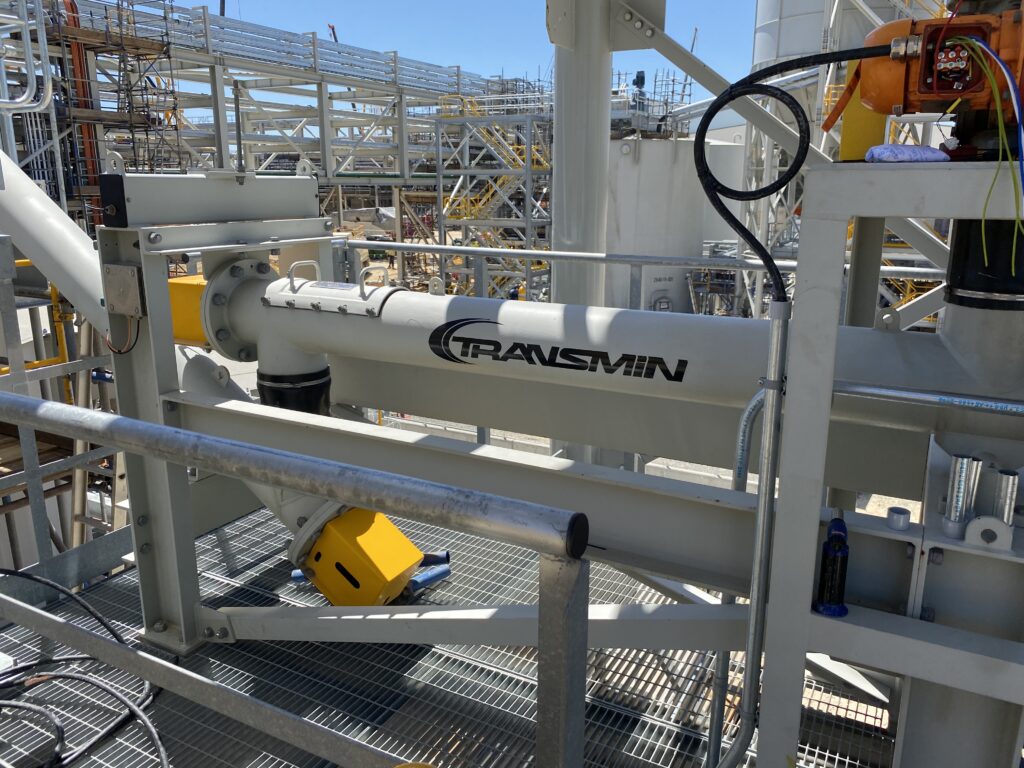
Heavy-duty Transmin screw feeder in industrial processing plant.

Aplicaciones de Alimentador de Tornillo de Uso Ruedo

Mover materiales a granel de un punto a otro es un desafío que varía enormemente dependiendo de lo que se esté manejando. Algunos materiales fluyen libremente y son predecibles; otros son abrasivos, corrosivos, pegajosos o están sujetos a temperaturas extremas. Un alimentador de tornillo aborda estos desafíos con un diseño simple y cerrado que proporciona un flujo controlado y medido para una amplia gama de aplicaciones industriales.

Este artículo desglosa las ventajas clave de los alimentadores de tornillo, las aplicaciones que cumplen y la gama de materiales a granel que manejan eficazmente.

Heavy-duty Transmin screw feeder in industrial processing plant.

Ventajas de los alimentadores de tornillo

El alimentador de tornillo es uno de los equipos más versátiles en el manejo de materiales a granel. Su diseño central —un tornillo helicoidal giratorio dentro de una tolva o tubo cerrado— mueve el material a una velocidad controlada, lo que lo hace adecuado para aplicaciones donde la precisión, la contención y la fiabilidad son importantes.

1. Compacto y eficiente en espacio

Los transportadores de tornillo ocupan una huella relativamente pequeña en comparación con otros sistemas de transporte. Esto los hace ideales para plantas de procesamiento, refinerías e instalaciones industriales donde el espacio es limitado. Los transportadores de tornillo verticales llevan esto un paso más allá, moviendo material hacia arriba en un espacio reducido con fácil acceso para el mantenimiento.

2. Medición precisa de materiales

Una de las características más valiosas de un alimentador de tornillo es su capacidad para dosificar material a una velocidad controlada y constante. Al ajustar la velocidad del accionamiento, los operadores pueden establecer tasas de alimentación precisas para reducir la carga de sobretensión, mejorar la eficiencia del proceso y proteger los equipos posteriores de la sobrecarga.

3. Diseño cerrado para control de polvo y derrames

A diferencia de los sistemas de transferencia abierta, un alimentador de tornillo opera dentro de una tolva o tubo cerrado. Esto contiene el polvo, minimiza los derrames y mejora la limpieza en las áreas de procesamiento. Para las industrias que manejan polvos finos o materiales ambientalmente sensibles, el transporte cerrado puede mejorar tanto la limpieza operativa como la seguridad en el lugar de trabajo.

4. Adecuado para materiales difíciles

Los alimentadores de tornillo son capaces de manejar una amplia variedad de materiales a granel, incluyendo polvos, gránulos, arena, cemento, cal, concentrados minerales, agregados y productos de desecho industrial. Diferentes diseños de tornillo se pueden adaptar para satisfacer diversas características del material, incluyendo productos abrasivos, pegajosos o con alta humedad.

Aplicaciones de alimentador de tornillo

Transmin los alimentador de tornillo de alta resistencia los sistemas se utilizan en diversas industrias donde la transferencia controlada de materiales y un rendimiento confiable son innegociables.

Minería y procesamiento de minerales

Las operaciones mineras comúnmente utilizan alimentadores de tornillo para transferir minerales finos, concentrados, reactivos y minerales procesados entre etapas del equipo. En estos entornos, los alimentadores de tornillo ayudan a mantener un flujo controlado hacia transportadores, sistemas de mezcla, equipos de procesamiento, silos de almacenamiento y sistemas de empaque. Su operación cerrada también ayuda a reducir la generación de polvo al manipular productos minerales secos o finos.

2. Operaciones de cemento y canteras

Las plantas de cemento y las operaciones de canteras dependen de alimentadores de tornillo para el manejo de materiales en polvo y granulares como cemento, cenizas volantes, cal y agregados. El control de alimentación constante proporcionado por un alimentador de tornillo soporta procesos estables de dosificación y mezcla, al tiempo que reduce el desperdicio de material.

3. Plantas de procesamiento industrial

Los alimentadores de tornillo se usan ampliamente en operaciones químicas, de fertilizantes, procesamiento de alimentos y manufactura donde los materiales necesitan ser transferidos de manera segura y consistente. Dependiendo de la aplicación, los sistemas pueden diseñarse para alimentación dosificada, caudal variable, materiales a alta temperatura, productos corrosivos o ambientes de procesamiento higiénico.

4. Aplicaciones de Residuos y Reciclaje

En las operaciones de manejo de residuos, los alimentadores de tornillo ayudan a mover lodos, cenizas, biomasa, materiales reciclados y subproductos industriales a través de los sistemas de procesamiento. El diseño cerrado contiene olores, polvo y contaminantes en la fuente, reduciendo el riesgo de contaminación cruzada y manteniendo las áreas de procesamiento en cumplimiento con los requisitos ambientales y de seguridad.

Manejo de Materiales a Granel con Alimentador de Tornillo

Un alimentador de tornillo bien especificado maneja de manera confiable una amplia variedad de materiales a granel. Los siguientes se encuentran entre los materiales para los que se especifican con mayor frecuencia los alimentadores de tornillo de Transmin:

  • Cal y cal viva: utilizados ampliamente en la minería, procesamiento de minerales, neutralización de ácidos y tratamiento de aguas residuales. Transmin ha suministrado alimentadores de tornillo para aplicaciones de cal viva en varias instalaciones de procesamiento de Australia Occidental.
  • Piedras y minerales: incluyendo mineral de hierro, mineral de cobre, níquel y materiales similares de alta densidad que requieren construcción robusta y componentes resistentes al desgaste.
  • Cemento y concentrados en polvo: materiales secos y finos donde el diseño cerrado de un alimentador de tornillo es esencial para el control de polvo y la dosificación precisa.
  • Granos: productos agrícolas de flujo libre que se benefician del manejo suave y consistente que proporciona un alimentador de tornillo.
  • Materiales corrosivos y de alta temperatura: las aplicaciones que involucran condiciones extremas, incluyendo entornos de presión o vacío, se manejan con construcción de acero inoxidable y arreglos de sellado apropiados.

Para operaciones que integran múltiples tecnologías de transporte, Transmin también soporta más amplias soluciones para el manejo de materiales a granel en entornos de minería y procesamiento industrial.

Especifica el alimentador de tornillo correcto para tu aplicación

Los alimentadores de tornillo son una solución confiable y eficiente en cuanto a espacio para una amplia gama de desafíos de manejo de materiales a granel. Desde la minería y la cantería hasta el procesamiento químico y el manejo de residuos, un alimentador de tornillo diseñado correctamente mejora la eficiencia del transporte, reduce la pérdida de material y respalda un rendimiento confiable de la planta en condiciones exigentes.

Transmin ofrece una amplia gama de alimentadores de tornillo industriales de alta resistencia, incluidos modelos Scutti estándar y soluciones diseñadas a medida, respaldados por casi 40 años de experiencia en ingeniería.

Ponte en contacto con nuestro equipo para analizar tu postulación y encontrar el ajuste adecuado.

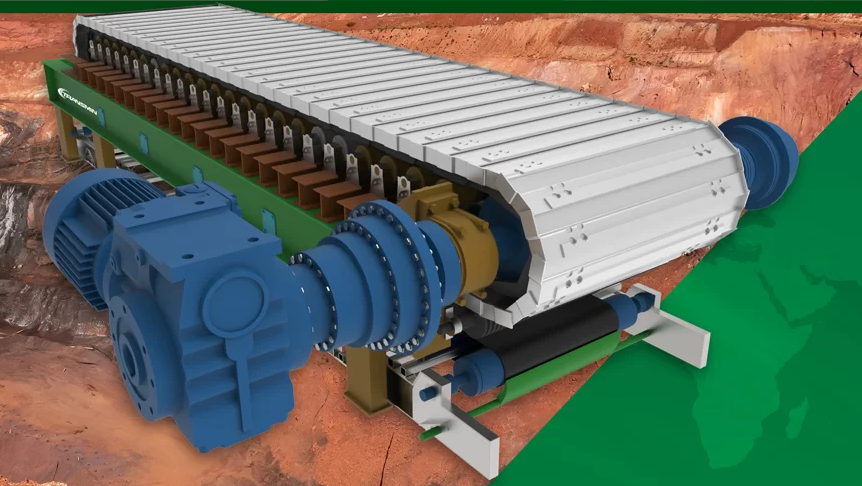
3D render of a heavy-duty apron feeder with a blue motor in a mining environment.

¿Condiciones difíciles? Transportadores de parrilla para aplicaciones de alta resistencia

Run-of-mine ore arriving directly from the pit is about as unforgiving a feed source as you will find. Oversized rock, unpredictable lump size, high impact loads, and continuous duty mean most feeders are not built to handle all of that at once.

Heavy-duty alimentadores de delantal are built specifically for those conditions. When the material is heavy, abrasive, and arriving at volume, apron feeders are the equipment most operations turn to first.

3D render of a heavy-duty apron feeder with a blue motor in a mining environment.

Why choose an apron feeder over a conventional one?

Conventional belt feeders perform well in standard conditions, but they have clear limitations. Rubber belts degrade rapidly under sustained impact loads, abrasive materials, and high-temperature environments. When the application involves heavy, jagged ROM rock or continuous high-tonnage duty, belt feeders simply cannot keep pace.

An apron feeder uses interlocking steel pans mounted on heavy-duty chains to form a continuous, rigid carrying surface. The all-steel construction absorbs the kind of impact loads and sustained stress that would quickly destroy a rubber belt. That makes it well suited to applications where material is being loaded directly from trucks, loaders, or hoppers at high volume.

Beyond raw durability, apron feeders also deliver precise, controlled feed rates to downstream crushers, screens, and conveyors. Uncontrolled surges in high-throughput operations cause bottlenecks, accelerated wear, and costly unplanned downtime. Apron feeders eliminate that risk.

Common applications of apron feeders

  • Run-of-mine ore handling
  • Primary crushing circuits
  • Stockpile reclaim
  • High-capacity material transfer
  • High-temperature and abrasive material handling

Benefits of apron feeders for heavy-duty applications

1. Rugged construction

The steel pan design, robust frame, reinforced chain system, and industrial-grade components are selected to withstand continuous loads in harsh mining conditions. Transmin’s heavy-duty apron feeders are custom-designed with pan widths up to 4 metres, engineered to suit the specific application rather than adapted from a standard catalogue product. Transmin also uses BERCO SALT chain, sprockets, wheels, and rollers, components proven in the most demanding ROM applications at D9 and D11 dozer-level duty.

This construction makes apron feeders suited to operations handling iron ore, copper ore, gold ore, lithium, aggregates, and other high-density bulk solids. They are also a reliable choice for high-temperature applications, including materials exceeding 200°C, where rubber belts would quickly fail. It is one of the primary reasons apron feeders remain the preferred choice for primary feeding applications across the mining industry.

2. Impact resistance

Impact loading is one of the biggest challenges in bulk materials handling. The steel pan design absorbs impact forces far more effectively than conventional rubber belts, significantly reducing the risk of deformation, tearing, or premature failure beneath dump hoppers, primary crushers, and truck unloading stations where high-impact loads are unavoidable.

In demanding mining environments, this directly translates into longer service intervals and lower replacement costs over the life of the equipment.

3. Material handling capabilities

Apron feeders handle a wide range of materials that cause problems for conventional equipment. Large lump sizes, wet and sticky ores, highly abrasive material, and variable feed rates at high tonnage are all within their scope. The chain-driven steel pan design keeps material moving reliably even under difficult conditions, and the pan geometry Transmin uses minimises material leakage on the return.

For applications requiring an ultra-low profile or a combined feeder-conveyor layout that transitions from horizontal to inclined within a single machine, Transmin’s Low Profile Feeder (LPF) is worth considering, with belt widths up to 4 metres and throughput of 6,000 tph and above.

4. Controlled material flow

Consistent material flow is critical for downstream processing efficiency. Uncontrolled surges or erratic feed rates accelerate wear on crushers and disrupt plant performance. In high-throughput operations, that is an expensive problem to manage after the fact.

Transmin’s apron feeders are available with optional variable speed drive, giving operators real-time control over feed rates and protecting downstream equipment from surge loading. Pairing the feeder with quality conveyor components downstream further optimises the flow of material through your handling system, reducing bottlenecks and improving overall productivity.

Finding the right apron feeder for your operation

When operations involve abrasive materials, high-impact loading, and continuous heavy-duty operation, apron feeders remain one of the most reliable solutions available. Choosing the wrong feeder leads to accelerated wear, unplanned downtime, and throughput bottlenecks that affect your entire operation.

Transmin has nearly 40 years of experience specifying and supplying feeders across the full range of bulk materials handling applications, from heavy-duty ROM operations in the Pilbara to process environments worldwide. If you are working through a feeder selection for a new project or a replacement, the Transmin engineering team is worth talking to early.

Get in touch with the Transmin team today to talk through your application.

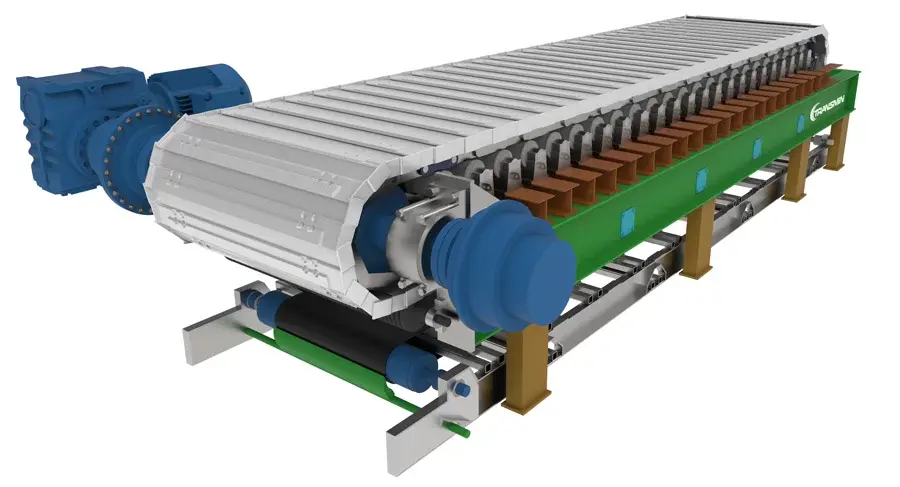
3D rendering of an industrial apron feeder conveyor

Cómo elegir la zaranda transportadora correcta: Una guía práctica para operaciones mineras y de materiales a granel

Apron feeders are key to some of the most demanding environments in mining and bulk materials handling, but selecting the right one requires more than a quick spec check. Get it right, and you have a piece of equipment that will perform consistently for years. Get it wrong, and you are looking at costly downtime, accelerated wear, and throughput bottlenecks you could have avoided.

This guide walks through the key considerations to help you make a well-informed decision.

3D rendering of an industrial apron feeder conveyor

What is an apron feeder?

An apron feeder is a heavy-duty material handling machine that uses interlocking steel pans mounted on chains to form a continuous moving surface. This surface carries materials steadily from one point to another, without slipping or spilling, while distributing loads evenly across the structure.

Unlike conventional belt conveyors that degrade under sustained stress, apron feeders are built for conditions where standard equipment simply would not last. High temperatures, corrosive environments, continuous run-of-mine (ROM) duty, heavy and abrasive ores: these are the applications where an apron feeder proves its value. The steel pan design absorbs impact loads that would destroy a rubber belt, making the apron feeder conveyor the logical choice where material is being loaded directly from trucks, loaders, or hoppers at volume.

They are also highly versatile. Apron feeders serve as primary feeders beneath stockpiles and hoppers, as reclaim feeders, and as a controlled feed source to crushers, screens, and downstream conveyors.

Factors to consider when selecting an apron feeder

1. Material type and size

Your material is the starting point for every design decision. Free-flowing granular materials like gravel require relatively simple configurations, while high-density materials such as iron ore demand more powerful drive systems. For low-density materials, feeder speed needs careful calibration to hit the required tonnes per hour.

Moisture content affects flow behaviour significantly. Wet, sticky materials need self-cleaning features to prevent build-up, while very dry or fine materials introduce dust control requirements. Particle size and gradation round out the picture: oversized or irregular feed places different loads on the pans and chain, so understanding the full size range is essential before specifying equipment.

2. Capacity and throughput requirements

Define your normal and peak feed rates before selecting a drive system. Where throughput is consistent, a fixed-speed drive is straightforward and cost-effective. Where demand fluctuates, a variable speed drive gives you real-time control and protects downstream equipment from surge loading. Electric drives suit continuous-duty operations, while hydraulic drives handle high-torque starting conditions well. Transmin’s alimentadores de delantal are available with optional hydraulic drive for demanding applications.

3. Feeding and discharging conditions

The hopper shear length, the opening dimension directly above the feeder, is one of the most important sizing parameters and directly influences drive system selection. The loading method matters too: impact loads from trucks or loaders must be accounted for in the feed inlet design to prevent premature wear.

On the discharge side, feeding into a crusher requires careful attention to chute design and feed rate control, while discharging onto a downstream apron feeder conveyor introduces belt speed and trajectory considerations.

4. Operating angle

Steeper angles suit free-flowing materials, while wet or viscous materials need a shallower incline to maintain consistent flow. If your application requires a horizontal-to-inclined transition within a single machine, Transmin’s Alimentador de bajo perfil is designed for exactly that.

5. Site and environmental conditions

High-temperature applications such as molten slag transport require heat-resistant construction throughout, making an all-steel apron feeder the only practical option. Cold environments may need insulation provisions. Site altitude affects motor cooling, so electrical specifications must be confirmed against local conditions, and physical space constraints should be established early to avoid costly design changes later.

6. Customisation and design options

No two sites are identical. Belt widths, pan configurations, drive arrangements, and ancillary equipment such as dribble conveyors can all be tailored to your application. Transmin’s alimentadores de delantal are custom designed with belt widths up to 3 metres. For applications needing an ultra-low profile or a combined feeder-conveyor solution, the Alimentador de bajo perfil extends the range further, with belt widths up to 4 metres and throughput of 6,000 tph and above.

Getting the right equipment for your application

Selecting the right apron feeder is a technical decision with long-term operational consequences. The factors above do not exist in isolation: material characteristics, throughput requirements, site conditions, and discharge arrangements all interact, and a change in any one of them can influence the others.

Transmin’s engineering team has over 35 years of experience specifying and supplying feeders for the full range of bulk materials handling applications, from heavy-duty ROM operations in the Pilbara to challenging process environments worldwide. Our team can help you work through the variables and identify the best solution.

Ponte en contacto with us to discuss your application and find the right feeder for your operation.

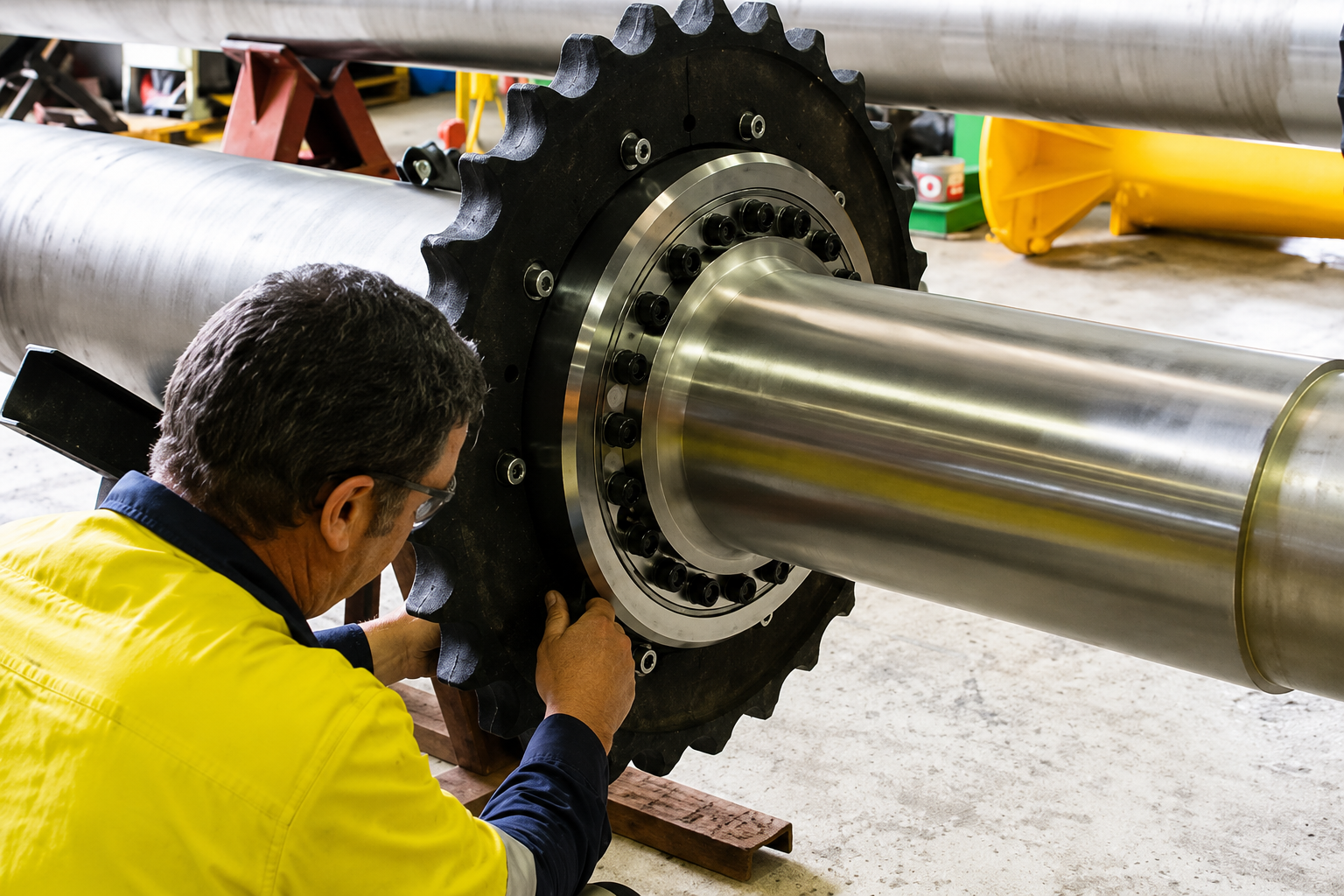
Worker installing a large sprocket

Cómo el servicio posventa extiende la vida útil de su equipo

Your heavy equipment represents a significant investment in your business and operational efficiency. With the right maintenance approach and aftermarket servicing, you can protect that investment, reduce operating costs, avoid unexpected breakdowns, and improve overall site productivity and safety.

In this article, we explain the different benefits and ways that aftermarket servicing can extend equipment lifecycles.

What is aftermarket servicing?

Aftermarket servicing refers to the maintenance, repairs, parts replacement, troubleshooting and lifecycle support provided after original equipment purchase and installation. It often includes scheduled maintenance, remote diagnostics, on-site inspections, refurbishment and access to specialised parts. A comprehensive aftermarket service capability supports equipment throughout its lifecycle, from commissioning through ongoing operation and eventual overhaul or replacement.

Key benefits of aftermarket serving

1. Extended equipment lifespan

Regular preventive maintenance and servicing are among the most reliable ways to extend the life of your machinery. Heavy industrial equipment that operates in harsh environments is especially susceptible to wear and tear. Without systematic care, minor issues can escalate into major breakdowns that significantly shorten service life.

In contrast, structured aftermarket servicing ensures components are inspected, lubricated, adjusted and replaced as necessary. This proactive approach helps avoid catastrophic failures and keeps equipment operating closer to its optimal performance thresholds.

2. Cost efficiency

It may seem counterintuitive, but investing in regular aftermarket servicing reduces long-term costs. Reactive repairs and unplanned downtime often lead to expensive emergency call-outs, lost productivity and secondary damage to surrounding components. Preventive servicing allows issues to be identified and resolved before they escalate into major failures. It enables maintenance to be scheduled during planned shutdowns rather than urgent stoppages, improving cost predictability and minimising disruption to operations. Over time, this structured approach maximises return on investment by keeping equipment running longer and more consistently while lowering overall lifecycle expenditure.

3. Optimised performance

Maintenance is not only about preventing breakdowns. Aftermarket servicing also ensures equipment continues to operate at peak efficiency throughout its lifecycle. Regular inspections, calibration, component adjustments and timely parts replacement help machinery perform closer to its original design specifications.

When equipment is maintained correctly, it runs more smoothly, consumes energy more efficiently and delivers more consistent output. This reduces strain on critical components and lowers the likelihood of performance-related faults. Optimised performance also supports safer operating conditions and maintains equipment that is less prone to sudden failure or unpredictable behaviour. Over time, this consistent operational reliability contributes to higher site productivity and improved overall performance.

Choosing the right aftermarket service provider

Not all service providers are equal. When selecting a partner to support your equipment, consider:

  • Lifecycle experience: Look for a provider with experience supporting equipment end-to-end, from commissioning to decommissioning.
  • Parts availability: Fast access to genuine and suitable replacement parts can dramatically reduce downtime and prevent secondary failure.
  • Remote support capabilities: Providers that offer remote diagnostics and virtual assistance can resolve issues faster and reduce travel costs.
  • Track record in your industry: Choose a service partner familiar with the demands of your operational environment and the specific equipment brands you rely on.

Keep your equipment reliable, your operations productive, and your costs predictable. Choose Transmin as your aftermarket service partner who understands your machines and your business.

Get in touch to learn more.