
Tough Conditions? Apron Feeders for Heavy-Duty Applications
Run-of-mine ore arriving directly from the pit is about as unforgiving a feed source as you will find. Oversized rock, unpredictable lump size, high impact loads, and continuous duty mean most feeders are not built to handle all of that at once.
Heavy-duty apron feeders are built specifically for those conditions. When the material is heavy, abrasive, and arriving at volume, apron feeders are the equipment most operations turn to first.
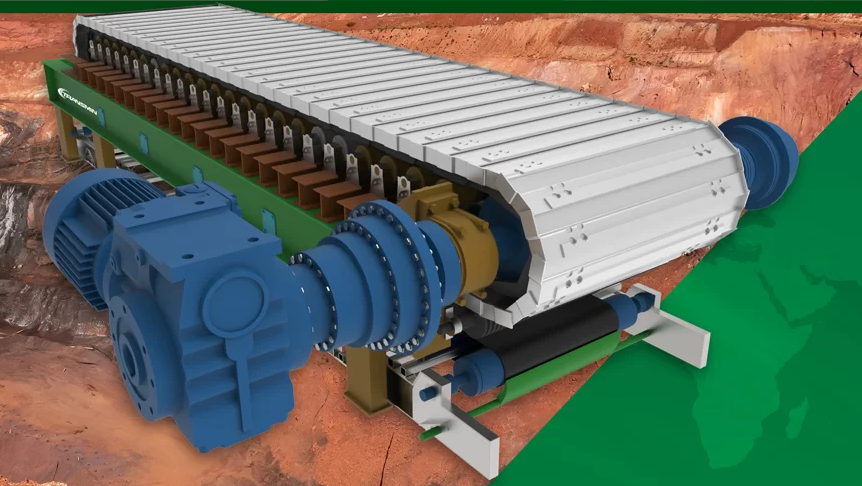
Why choose an apron feeder over a conventional one?
Conventional belt feeders perform well in standard conditions, but they have clear limitations. Rubber belts degrade rapidly under sustained impact loads, abrasive materials, and high-temperature environments. When the application involves heavy, jagged ROM rock or continuous high-tonnage duty, belt feeders simply cannot keep pace.
An apron feeder uses interlocking steel pans mounted on heavy-duty chains to form a continuous, rigid carrying surface. The all-steel construction absorbs the kind of impact loads and sustained stress that would quickly destroy a rubber belt. That makes it well suited to applications where material is being loaded directly from trucks, loaders, or hoppers at high volume.
Beyond raw durability, apron feeders also deliver precise, controlled feed rates to downstream crushers, screens, and conveyors. Uncontrolled surges in high-throughput operations cause bottlenecks, accelerated wear, and costly unplanned downtime. Apron feeders eliminate that risk.
Common applications of apron feeders
- Run-of-mine ore handling
- Primary crushing circuits
- Stockpile reclaim
- High-capacity material transfer
- High-temperature and abrasive material handling
Benefits of apron feeders for heavy-duty applications
1. Rugged construction
The steel pan design, robust frame, reinforced chain system, and industrial-grade components are selected to withstand continuous loads in harsh mining conditions. Transmin’s heavy-duty apron feeders are custom-designed with pan widths up to 4 metres, engineered to suit the specific application rather than adapted from a standard catalogue product. Transmin also uses BERCO SALT chain, sprockets, wheels, and rollers, components proven in the most demanding ROM applications at D9 and D11 dozer-level duty.
This construction makes apron feeders suited to operations handling iron ore, copper ore, gold ore, lithium, aggregates, and other high-density bulk solids. They are also a reliable choice for high-temperature applications, including materials exceeding 200°C, where rubber belts would quickly fail. It is one of the primary reasons apron feeders remain the preferred choice for primary feeding applications across the mining industry.
2. Impact resistance
Impact loading is one of the biggest challenges in bulk materials handling. The steel pan design absorbs impact forces far more effectively than conventional rubber belts, significantly reducing the risk of deformation, tearing, or premature failure beneath dump hoppers, primary crushers, and truck unloading stations where high-impact loads are unavoidable.
In demanding mining environments, this directly translates into longer service intervals and lower replacement costs over the life of the equipment.
3. Material handling capabilities
Apron feeders handle a wide range of materials that cause problems for conventional equipment. Large lump sizes, wet and sticky ores, highly abrasive material, and variable feed rates at high tonnage are all within their scope. The chain-driven steel pan design keeps material moving reliably even under difficult conditions, and the pan geometry Transmin uses minimises material leakage on the return.
For applications requiring an ultra-low profile or a combined feeder-conveyor layout that transitions from horizontal to inclined within a single machine, Transmin’s Low Profile Feeder (LPF) is worth considering, with belt widths up to 4 metres and throughput of 6,000 tph and above.
4. Controlled material flow
Consistent material flow is critical for downstream processing efficiency. Uncontrolled surges or erratic feed rates accelerate wear on crushers and disrupt plant performance. In high-throughput operations, that is an expensive problem to manage after the fact.
Transmin’s apron feeders are available with optional variable speed drive, giving operators real-time control over feed rates and protecting downstream equipment from surge loading. Pairing the feeder with quality conveyor components downstream further optimises the flow of material through your handling system, reducing bottlenecks and improving overall productivity.
Finding the right apron feeder for your operation
When operations involve abrasive materials, high-impact loading, and continuous heavy-duty operation, apron feeders remain one of the most reliable solutions available. Choosing the wrong feeder leads to accelerated wear, unplanned downtime, and throughput bottlenecks that affect your entire operation.
Transmin has nearly 40 years of experience specifying and supplying feeders across the full range of bulk materials handling applications, from heavy-duty ROM operations in the Pilbara to process environments worldwide. If you are working through a feeder selection for a new project or a replacement, the Transmin engineering team is worth talking to early.
Get in touch with the Transmin team today to talk through your application.